How to Choose a Bathroom Vanity: Materials, Sizes, and Styles
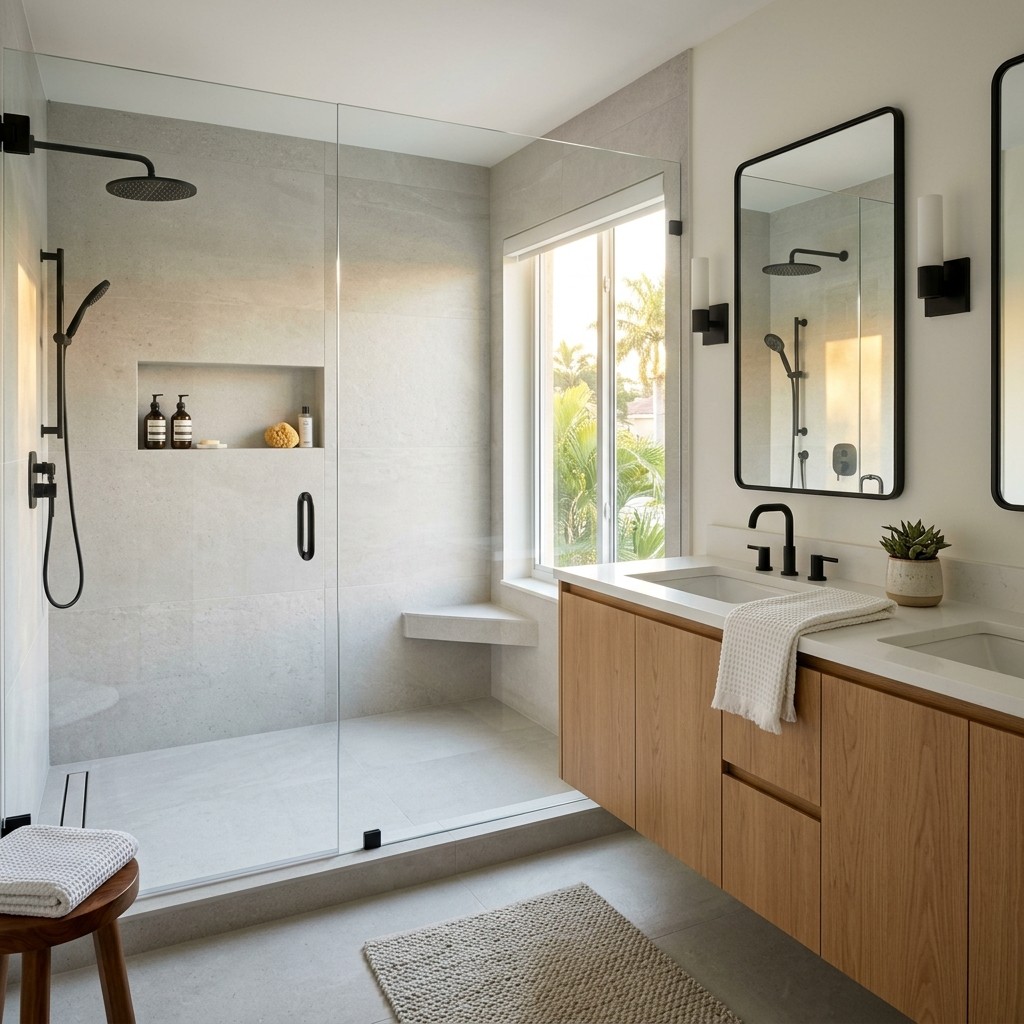
The Vanity Sets the Tone
If the shower is the workhorse of a bathroom, the vanity is the first thing people notice. It anchors the room. It sets the style. And when it is wrong, everything else feels off.
We see it constantly in Miami-Dade homes. A homeowner picks a gorgeous tile, installs beautiful fixtures, then drops in a cheap vanity from a big box store. Within two years, the doors swell from humidity, the finish peels, and the whole bathroom looks ten years older than it is.
Choosing the right vanity is not just about looks. In South Florida, it is about survival. Our humidity destroys weak materials fast. So let's break down what actually works.
Single vs Double Vanity
This decision comes down to space and how many people use the bathroom daily.
Single vanity. Standard widths are 24, 30, and 36 inches. A 30-inch single vanity works for most guest bathrooms and smaller master baths. If your bathroom is under 50 square feet, a single vanity is usually the right call.
Double vanity. Standard widths are 48, 60, and 72 inches. A 60-inch double vanity is the sweet spot for most master bathrooms. You get two sinks, two mirrors, and enough counter space for two people. If you have the room, this is the upgrade that makes mornings smoother.
The half-measure: 48-inch single sink. If you want counter space but do not need two sinks, a 48-inch vanity with one centered sink gives you plenty of room on both sides. This is underrated and works great in mid-size bathrooms.
Price difference? A single vanity runs $300 to $1,200 for the cabinet alone. A double vanity runs $600 to $2,500. Add $200 to $800 for countertops and sinks on top of that.
Floating vs Freestanding
This is where style meets function.
Floating (wall-mounted) vanities. These mount directly to the wall with no legs touching the floor. They make small bathrooms look bigger because you can see the floor underneath. They are easier to clean under. And they give the bathroom a modern, current look.
The catch: floating vanities need to be mounted into studs or blocking in the wall. If your wall is not reinforced, your installer needs to add backing. This is standard work during a remodel but adds cost if you are just swapping a vanity in an existing bathroom.
Floating vanities also limit storage slightly. Since they are not touching the floor, you lose the bottom shelf or drawer space that a freestanding unit provides.
Freestanding vanities. These sit on the floor like furniture. They are easier to install, offer more storage, and come in a wider range of styles from traditional to modern. If your bathroom has a classic or transitional design, a freestanding vanity usually fits better.
For most Miami master bathrooms, we recommend freestanding vanities with furniture-style legs. They keep the cabinet off the floor (which helps with humidity and cleaning) while still offering full storage inside.
Materials: What Survives Miami's Humidity
This is where most people make expensive mistakes. The wrong material in a Miami bathroom will swell, warp, peel, or grow mold within a few years. Here is what works and what does not.
Solid wood (good). Hardwoods like oak, maple, and poplar hold up well if properly sealed and finished. A quality solid wood vanity with a water-resistant finish will last 15 to 20 years even in Miami's humidity. Expect to pay $800 to $2,000 for a quality solid wood vanity cabinet.
Plywood construction (best for the money). Plywood is layers of wood glued together with the grain alternating direction. This makes it stronger and more moisture-resistant than solid wood. Most mid-range to high-end vanities use plywood boxes with solid wood doors. This is the best combination of durability and price. Plywood vanities run $500 to $1,500.
MDF and particleboard (risky). MDF (medium-density fiberboard) is compressed wood fibers. Particleboard is even cheaper, made from wood chips and resin. Both absorb moisture like a sponge. In a humid Miami bathroom, MDF doors can swell within 18 months. Particleboard is worse.
If you are on a tight budget and MDF is your only option, make sure the vanity has a thermofoil or laminate wrap that fully seals all surfaces, including the edges. Any exposed MDF edge will absorb water.
Engineered stone or resin cabinets. These are newer to the market. They do not absorb moisture at all. They are heavy, expensive, and limited in style options. But if you want a vanity that will literally never warp from humidity, this is it.
Countertop Options
The countertop takes as much abuse as the cabinet, maybe more. Here is what we recommend for Miami bathrooms:
Quartz ($50 to $120 per square foot installed). Engineered stone. Non-porous, does not stain, does not need sealing. This is our top recommendation for bathroom countertops. It comes in every color and pattern you can imagine, including options that look like marble without the maintenance.
Granite ($40 to $100 per square foot installed). Natural stone. Durable and beautiful. Needs to be sealed once a year. Still a solid choice, but quartz has overtaken it in popularity for bathrooms.
Marble ($60 to $150 per square foot installed). Gorgeous but high maintenance. Marble etches from acidic products (toothpaste, skincare, cleaners). It stains. It needs regular sealing. If you love the look, consider quartz that mimics marble instead.
Cultured marble ($30 to $70 per square foot installed). A cast resin material with a gel coat finish. It is affordable, comes with an integrated sink (one piece, no seams), and looks decent. It does not have the depth of real stone, but for a guest bathroom on a budget, it works.
Laminate ($15 to $40 per square foot installed). The most affordable option. Modern laminates look much better than they used to. They resist stains and moisture well. Not as durable as stone, but for a budget-conscious guest bath, they get the job done.
Sizes for Small Bathrooms
Small bathrooms are common in Miami-Dade, especially in condos, townhomes, and older homes. Here is how to choose a vanity when space is tight.
Under 35 square feet: Look at 18 to 24-inch vanities. A wall-mounted floating vanity in this size range keeps the floor visible and makes the room feel bigger. A pedestal sink is another option if you do not need storage, but you lose all counter space.
35 to 50 square feet: A 30 to 36-inch vanity fits comfortably. You have room for drawers and some counter space.
50 to 75 square feet: A 48-inch single or a compact 48-inch double vanity works. This is the range where you start having real options.
Over 75 square feet: Go with a 60 or 72-inch double vanity. You have the space. Use it.
One trick for small bathrooms: choose a vanity with drawers instead of doors. Drawers pull out fully and let you access everything inside. Cabinet doors in a tight bathroom mean you are always reaching around the door to get to the back.
Popular Styles in Miami Homes
Modern/Contemporary. Clean lines, flat-panel doors, no ornate details. Floating vanities, matte finishes, integrated sinks. This is the dominant style in newer Miami homes and condos.
Transitional. A blend of modern and traditional. Shaker-style doors (simple recessed panel), brushed nickel or matte black hardware, quartz countertops. This is the most popular style for whole-home remodels because it ages well and appeals to most buyers.
Traditional. Raised panel doors, decorative feet, ornate hardware. Think dark wood tones with granite countertops. Still popular in Coral Gables, Pinecrest, and older neighborhoods with classic architecture.
Farmhouse/Rustic. Open shelving, reclaimed wood looks, vessel sinks, barn-style details. Has a following in Miami but works best in specific homes, not everywhere.
For resale value, transitional style performs best. It does not date as fast as modern trends and does not feel as heavy as full traditional. If you are remodeling to sell, go transitional.
Installation Matters
A great vanity installed poorly is worse than a cheap vanity installed right. Here is what proper installation includes:
Level and plumb. The vanity must be perfectly level. Miami homes often have uneven floors, especially in older construction. Shims and adjustments are normal.
Proper wall mounting. Floating vanities need to be secured to studs or blocking. The vanity must hold the weight of the countertop, sink, and whatever you store inside.
Plumbing connections. Supply lines, drain connections, and shut-off valves need to be accessible. We always install quarter-turn shut-off valves so you can turn off water quickly if there is ever a leak.
Caulk and seal. The joint between the countertop and the wall gets a clean bead of silicone caulk to prevent water from running behind the vanity. Same with the backsplash.
Ready to Choose?
If you are planning a bathroom remodel in Miami-Dade, the vanity is one of the most important decisions you will make. We help homeowners in Kendall, Doral, Palmetto Bay, The Hammocks, and across Miami-Dade pick vanities that look great and hold up in our climate.
Call Broke & Fixed Home Solutions at (786) 363-7039 for a free consultation. We will measure your space, talk through your options, and help you find the right vanity for your bathroom and your budget.
Ready to start your Miami remodel?
Free in-home estimate. We will give you clear next steps.