Best Kitchen Flooring for Miami Homes: A Practical Comparison
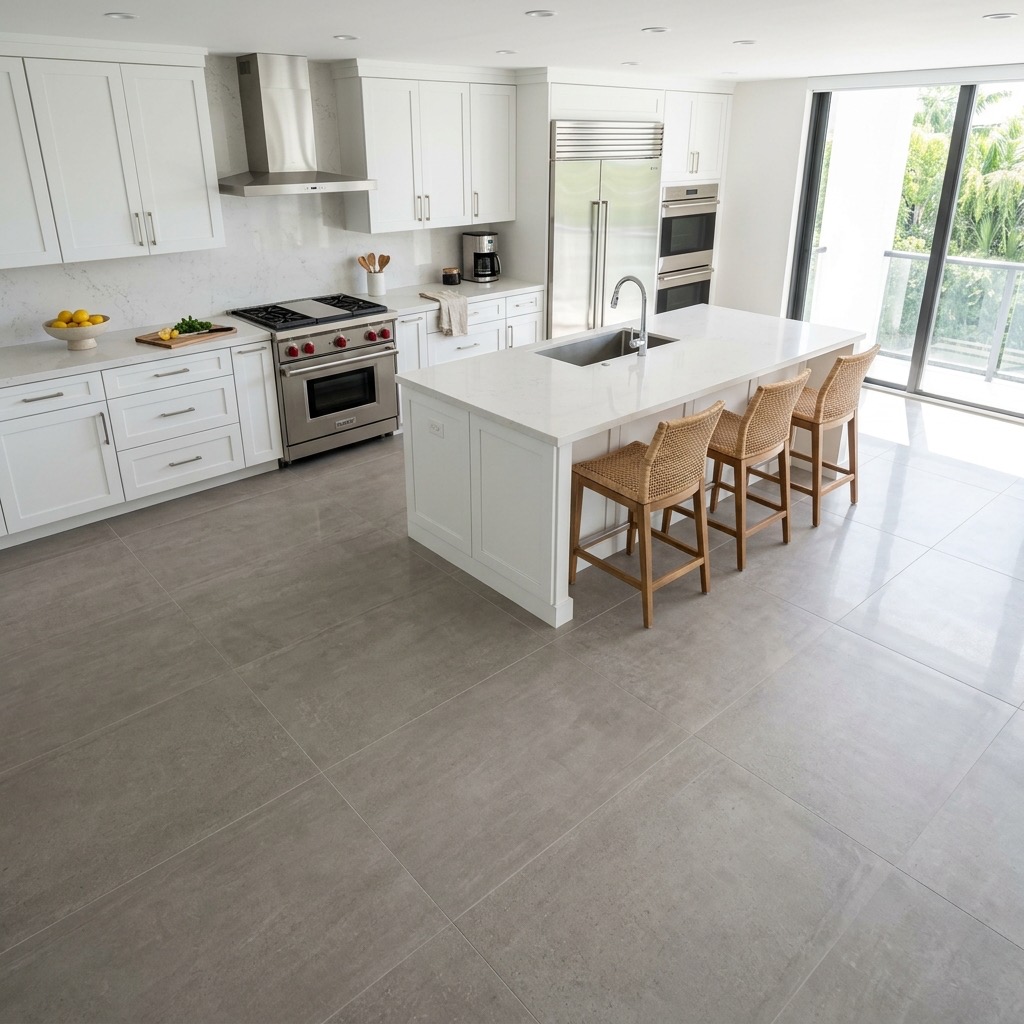
Short answer: porcelain tile. If you want the long answer, keep reading.
We install kitchen floors across Miami-Dade County, and we see the same mistakes over and over. Someone picks a floor that looks great in a showroom in North Carolina but falls apart in Miami humidity within two years. This guide is built from real experience working in real Miami homes.
Why Kitchen Flooring in Miami Is Different
Miami is not like the rest of the country. Your flooring has to deal with conditions that most national guides never mention.
Humidity. Miami averages 73% relative humidity year-round. Moisture does not just come from spills. It comes up through the slab. Most Miami homes sit on concrete slab foundations with no basement. That slab absorbs ground moisture and pushes it upward. Any flooring that cannot handle moisture from below will eventually buckle, warp, or grow mold underneath.
Heat. Summer temperatures push into the 90s for months. Your slab stays cooler than the air, which is actually a benefit. Tile and stone floors feel great barefoot in July. But heat also means some materials off-gas volatile compounds faster than they would in cooler climates. That matters for certain vinyl products.
Spills and traffic. Kitchens take more abuse than any other room. Water from the sink. Grease splatters. Dropped pots. Heavy appliances dragged across the floor. Your kitchen floor needs to handle all of it without cracking, staining, or scratching.
Salt air. If you live near the coast (and in Miami-Dade, that is most of us), salt air corrodes certain metals and degrades some adhesives faster than you would expect. This affects installation materials, not just the flooring itself.
The 5 Best Kitchen Flooring Options for Miami
1. Porcelain Tile: Best Overall
Cost: $8 to $18 per square foot installed
Porcelain is the top choice for Miami kitchens, and it is not close. Here is why.
Porcelain tile has a water absorption rate below 0.5%. That means it is basically waterproof. Spills, slab moisture, humidity. None of it gets through. It handles heat without expanding or warping. It resists scratches, stains, and heavy impacts better than almost any other flooring material.
The style range is massive. You can get porcelain that looks like marble, wood, concrete, or terrazzo at a fraction of the cost of the real thing. Wood-look porcelain is especially popular right now because you get the warmth of hardwood without the warping risk.
Porcelain stays cool on concrete slabs. In a Miami summer, walking barefoot on porcelain tile feels like a reward.
The downsides. Porcelain is hard. If you stand on it for hours while cooking, your feet and back will feel it. A cushioned kitchen mat solves this, but it is worth knowing. Grout lines need sealing and occasional cleaning to prevent staining. And installation costs more than some alternatives because porcelain is heavier and harder to cut.
Best for: Any Miami kitchen. Period. Budget to luxury, small galley to open-concept. Porcelain works everywhere.
2. Ceramic Tile: Budget-Friendly Alternative
Cost: $6 to $14 per square foot installed
Ceramic tile is porcelain's more affordable cousin. It is made from the same basic materials (clay fired in a kiln) but at lower temperatures. That makes it slightly softer and more porous than porcelain.
For most Miami kitchens, ceramic works fine. It handles humidity well, cleans easily, and comes in hundreds of styles, colors, and patterns. You can get a great-looking ceramic floor for 30 to 40 percent less than porcelain.
The downsides. Ceramic absorbs more water than porcelain (1 to 3% absorption rate vs. under 0.5%). In a kitchen with heavy water exposure near the sink or dishwasher, this matters over time. Ceramic also chips more easily if you drop a cast iron pan on it. And it does not hold up as well in freeze-thaw cycles, though that is rarely an issue in Miami.
Best for: Budget kitchen remodels where you want a tile floor without the premium price. Great for kitchens with moderate traffic.
3. Luxury Vinyl Plank (LVP): Comfortable and Affordable
Cost: $5 to $12 per square foot installed
LVP has exploded in popularity. It is waterproof, comfortable underfoot, and gives you a convincing wood or stone look at the lowest price point on this list.
The comfort factor is real. LVP has a built-in underlayment that makes it softer to stand on than tile. If you spend a lot of time cooking, your feet will thank you. Installation is fast because most LVP clicks together over the existing subfloor without adhesive.
The downsides. Here is where we get honest. LVP has some real weaknesses in Miami.
First, off-gassing. Some LVP products release volatile organic compounds (VOCs), and Miami's heat speeds up that process. Cheaper LVP is worse for this. If you go the LVP route, spend extra on a brand with FloorScore or GreenGuard Gold certification.
Second, heavy appliances. Refrigerators and ranges can dent or deform LVP over time. You need furniture pads under every appliance leg, and even then, you may see impressions after a few years.
Third, resale value. LVP does not add value to your home the way tile or stone does. Buyers in Miami-Dade expect tile in kitchens. An LVP kitchen floor can actually work against you when selling.
Best for: Rental properties, tight budgets, or homeowners who prioritize comfort over longevity.
4. Natural Stone: Beautiful but High Maintenance
Cost: $15 to $35 per square foot installed
Marble. Travertine. Slate. These are stunning materials that make a kitchen feel like a showpiece. Natural stone has been used in high-end Miami homes for decades.
Each piece is unique. The veining in marble, the texture of travertine, the depth of slate. No manufactured tile can perfectly replicate it. If you want your kitchen floor to make a statement, natural stone delivers.
The downsides. Natural stone is porous. Every type of stone needs sealing, and that seal needs refreshing every 1 to 2 years. Skip a sealing cycle in Miami, and the humidity will find its way in. Staining, discoloration, and even mold growth can follow.
Marble scratches. Travertine pits. Slate flakes. Every stone has a weakness, and kitchen use exposes all of them. Acidic foods (lemon juice, tomato sauce, vinegar) etch marble on contact if the seal has worn thin.
Maintenance is not optional with natural stone. It is a commitment.
Best for: Homeowners who love the look, have the budget, and are willing to maintain it. Works well in kitchens that are more for entertaining than heavy daily cooking.
5. Terrazzo: Classic South Florida Character
Cost: $20 to $40 per square foot installed (new). $3 to $8 per square foot to refinish existing.
Terrazzo is South Florida's signature floor. Thousands of Miami homes built in the 1950s through 1970s have terrazzo under their carpet, tile, or laminate. If your home is from that era, there is a good chance you are walking on terrazzo right now and do not know it.
New terrazzo is expensive. It is poured in place, ground smooth, and polished. The process is labor-intensive and requires specialized equipment. But the result is a one-of-a-kind floor with chips of marble, glass, or quartz suspended in a cement or epoxy matrix.
The real value play: refinishing existing terrazzo. If your Miami home already has terrazzo underneath the current flooring, removing the top layer and refinishing the original terrazzo costs $3 to $8 per square foot. That is less than new ceramic tile and gives you a floor that will last another 50 years.
Terrazzo is extremely durable, water-resistant (when sealed), and cool underfoot. It also adds serious character to a kitchen. Buyers love original terrazzo in Miami homes.
Best for: Homes that already have terrazzo underneath. New builds or remodels where you want a truly unique, South Florida look and have the budget for it.
Kitchen Flooring Comparison Table
| Feature | Porcelain | Ceramic | LVP | Natural Stone | Terrazzo |
|---|---|---|---|---|---|
| Cost (installed/sqft) | $8-$18 | $6-$14 | $5-$12 | $15-$35 | $20-$40 (new) |
| Water Resistance | Excellent | Good | Excellent | Fair (needs sealing) | Good (needs sealing) |
| Durability | Excellent | Good | Fair | Good | Excellent |
| Maintenance | Low | Low | Low | High | Medium |
| Comfort Underfoot | Hard | Hard | Soft | Hard | Hard |
| Resale Value | High | Medium | Low | High | High |
| Miami Heat Rating | Excellent | Excellent | Fair | Good | Excellent |
| Style Options | Many | Many | Many | Natural only | Custom |
What NOT to Put in a Miami Kitchen
Some flooring materials that work fine in other parts of the country will fail in Miami. Save yourself the headache.
Hardwood. Real wood floors look incredible. In a Miami kitchen, they warp. The humidity from the air and the slab moisture from below create a double attack that no finish can fully prevent. We have seen gorgeous oak and maple kitchen floors buckle within 18 months of installation. Even engineered hardwood with a plywood core struggles in slab-on-grade Miami homes.
Laminate. Laminate is basically compressed wood fiber with a printed image on top. Water is its enemy. One dishwasher leak or a few months of slab moisture, and the edges swell, bubble, and separate. Do not put laminate in any Miami kitchen. Not even the "waterproof" kind.
Carpet. We should not have to say this, but we have seen it. Carpet in a kitchen traps grease, food particles, and moisture. In Miami's humidity, that becomes a mold factory. Just don't.
Slab Foundation Considerations
Almost every home in Miami-Dade sits on a poured concrete slab. No basement. No crawl space. This is important for flooring.
Concrete slabs absorb moisture from the ground. That moisture migrates upward through the slab in a process called moisture vapor transmission. The rate depends on the age of the slab, how well it was sealed during construction, and how much rain we have had recently.
Before installing any kitchen floor, a moisture test should be done on the slab. The calcium chloride test and the relative humidity probe test are the two standards. If moisture levels are too high, a moisture barrier or vapor retarder needs to go down before the flooring.
This is especially important for LVP and natural stone. Porcelain and ceramic handle slab moisture better because they do not trap it underneath the way floating floors can.
If your home was built before 1980, the slab likely has no modern vapor barrier. Factor that into your flooring decision.
Trending Kitchen Floor Patterns in Miami
The days of 12x12 tile in a straight grid are over. Here is what Miami homeowners are choosing now.
Large format tile. 24x24 and 24x48 inch tiles are the most popular choice. Fewer grout lines mean a cleaner look and less maintenance. Large format porcelain in a matte finish gives a modern, open feel. Just make sure your subfloor is flat. Large tiles show every imperfection.
Herringbone. This classic pattern is back. Using 4x12 or 6x24 planks laid at 45-degree angles creates movement and visual interest. Herringbone works especially well in narrow galley kitchens because it draws the eye and makes the space feel wider.
Wood-look porcelain planks. This is the biggest trend in Miami-Dade kitchen remodeling. You get the warmth and texture of real wood without any of the moisture problems. The best wood-look porcelain has textured surfaces that feel like real grain under your feet. Lay them in a staggered pattern for the most realistic effect.
Geometric patterns. Hexagon tiles, Moroccan-inspired patterns, and encaustic cement tiles are showing up in kitchens that want to make a bold statement. These work best as accents or in smaller kitchens where the pattern does not overwhelm the space.
Frequently Asked Questions
What is the best kitchen flooring for Miami humidity?
Porcelain tile is the best choice. Its water absorption rate is under 0.5%, making it nearly waterproof. It handles both airborne humidity and slab moisture without warping, swelling, or growing mold. Ceramic tile is a solid second choice for budget projects.
How much does it cost to tile a kitchen floor in Miami?
For a standard 150-square-foot kitchen, expect $900 to $2,700 for porcelain tile installed. Ceramic tile runs $900 to $2,100. These prices include materials, labor, thinset, grout, and basic prep. Removing old flooring or leveling the subfloor adds $2 to $4 per square foot.
Is LVP good for kitchens in South Florida?
LVP works for budget projects and rental properties. It is waterproof and comfortable underfoot. But it can off-gas in Miami heat, dents under heavy appliances, and does not add resale value. For a home you plan to keep, porcelain tile is a better long-term investment.
Can I put hardwood in my Miami kitchen?
We do not recommend it. Miami's year-round humidity and slab moisture cause real wood to expand, contract, and eventually warp. Even engineered hardwood struggles on concrete slabs without basements. If you want the wood look, choose wood-look porcelain tile instead.
How do I know if my Miami home has terrazzo under the floor?
Many homes built between 1950 and 1975 in Miami-Dade have original terrazzo. Check a closet or utility area where flooring may have been left exposed. You can also carefully pull up a floor register or peek at the edge where carpet meets a doorway. Refinishing existing terrazzo costs $3 to $8 per square foot.
How long does porcelain tile last in a kitchen?
Porcelain tile lasts 50 years or more with normal kitchen use. The tile itself is nearly indestructible. Grout may need resealing every 3 to 5 years, and individual tiles can be replaced if they crack from a heavy impact. It is the most durable kitchen flooring option available.
Ready to Pick Your Kitchen Floor?
At Broke & Fixed Home Solutions, we install all five flooring types covered in this guide. We work across Miami-Dade County and can help you choose the right material for your kitchen, your budget, and your lifestyle.
Whether you want classic porcelain, budget-friendly ceramic, or want us to check if there is original terrazzo hiding under your current floor, we are here to help.
We also handle full kitchen remodeling in Kendall and tile work in Coral Gables and throughout Miami-Dade.
Call (786) 363-7039 to schedule a free estimate. Or send us a message and we will get back to you within 24 hours.
Ready to start your Miami remodel?
Free in-home estimate. We will give you clear next steps.