DIY Painting vs Hiring a Pro: What Miami Homeowners Should Know
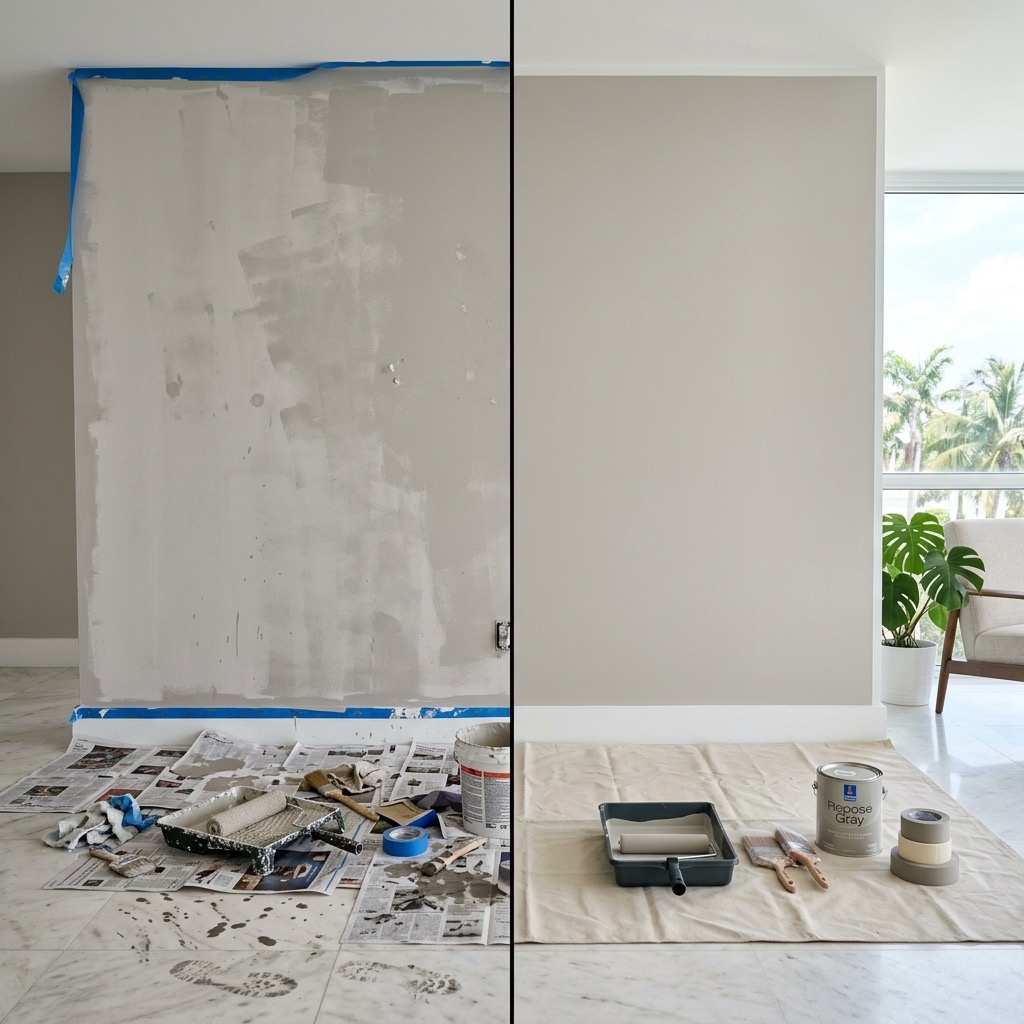
Sometimes DIY makes sense. Sometimes it doesn't. Here is how to decide.
We are a painting company, so you might expect us to tell you to always hire a pro. But that is not how we operate. Some projects are perfectly fine to do yourself. Others will cost you more time, money, and frustration than you expected. This guide gives you the real numbers so you can make the right call.
The Cost Comparison: DIY vs Professional Painting
Here is what a typical 3-bedroom, 2-bathroom home looks like when you break down costs side by side.
| Factor | DIY | Professional |
|--------|-----|-------------|
| Paint (walls + ceilings) | $200 to $400 (4-6 gallons) | Included in quote |
| Primer | $60 to $120 (2-3 gallons) | Included in quote |
| Brushes and rollers | $30 to $50 | Included |
| Painter's tape | $15 to $30 | Included |
| Drop cloths | $15 to $25 | Included |
| Ladder (if needed) | $40 to $80 rental | Included |
| Patching supplies | $15 to $30 | Included |
| Sandpaper and caulk | $10 to $20 | Included |
| Your time | 40 to 60 hours | 0 hours |
| Timeline | 2 to 4 weekends | 2 to 3 days |
| Total | $400 to $800 + your time | $2,500 to $5,000 |
Look at those numbers honestly. The material cost for DIY is real savings. But so are those 40 to 60 hours. If you make $25 an hour at work, that is $1,000 to $1,500 worth of your time. If you make $40 an hour, the math stops making sense for a whole house pretty fast.
When DIY Painting Makes Total Sense
There are real situations where doing it yourself is the right move. No shame in it.
A single accent wall. One wall, one color, straight edges at the ceiling and corners. You can knock this out in an afternoon. Buy a good angled brush, a quality roller, and decent paint. You will be fine.
A small bedroom or office. A 10x10 room with standard ceilings and minimal prep work is a manageable weekend project. Roll the walls, cut in the edges, and you are done.
You have a tight budget and free weekends. If the money genuinely is not there, but you have time on Saturday and Sunday, DIY saves you real cash. Just do not cheap out on paint quality. One coat of premium paint beats two coats of bargain paint every time.
You genuinely enjoy painting. Some people find it relaxing. If that is you, paint your heart out. We are not going to talk you out of a hobby.
Rental property touch-up. A quick touch-up between tenants on walls that are already in decent shape does not require a crew. A gallon of matching paint and a roller gets it done.
When You Should Hire a Professional
Here is where DIY starts falling apart for most homeowners.
Your whole house needs painting. Painting one room is manageable. Painting eight rooms, three hallways, and two bathrooms while living in the house is a logistical nightmare. You will be moving furniture, sleeping in rooms that smell like paint, and stepping over drop cloths for weeks.
High ceilings. Anything above 8 feet changes the game. At 9 or 10 feet, you need extension poles and proper ladder setups. Vaulted ceilings require scaffolding and experience working overhead. This is where DIY injuries happen.
Multiple rooms with different colors. Every color change means cleaning rollers, switching trays, precise taping, and careful cutting in. A pro crew handles this systematically. A homeowner spends 30 minutes between every color transition.
Textured walls or popcorn ceilings. These surfaces eat paint and create uneven coverage unless you know the technique. Textured walls need specific roller naps and heavier application. Get it wrong and you are doing three coats instead of two.
You need it done fast. Hosting guests next weekend? Listing your house for sale? A professional crew can paint a full home interior in 2 to 3 days. That same job will take you 3 to 4 weekends minimum.
Serious prep work is needed. Drywall repair, wallpaper removal, skim coating, or mildew treatment is not painting. It is surface preparation, and it requires tools and experience that most homeowners do not have. Bad prep ruins even expensive paint.
Cabinet painting. This deserves its own category. Cabinet painting requires removing doors, proper sanding, primer designed for slick surfaces, multiple thin coats, and careful reassembly. DIY cabinet painting is the single most regretted home project we hear about from new clients. Check our cabinet refinishing guide for what that process actually involves.
Exterior painting. Ladders, weather windows, surface prep on stucco, and safety concerns put exterior work firmly in professional territory. Check our stucco painting guide for more on exterior projects.
Hidden Costs of DIY That People Forget
The paint is never the only expense. Here is what catches first-time DIY painters off guard.
Good brushes cost real money. A quality 2.5-inch angled brush runs $12 to $18. A decent roller frame and covers cost $15 to $25. Cheap brushes leave bristles in your finish and cheap rollers shed lint. Buy once, cry once.
Painter's tape adds up. A single roll of FrogTape or ScotchBlue costs $6 to $8. A three-bedroom house can use 4 to 6 rolls just for the edges and trim. That is $25 to $50 you were not expecting.
Primer is not optional. Skipping primer on bare drywall, patched areas, or color changes means you need three coats of paint instead of two. A gallon of good primer is $30 to $40. Skipping it costs you more in paint than you saved.
Mistakes cost paint. Drips, roller marks, and uneven coverage all mean more paint. Most first-time painters use 20 to 30 percent more paint than they estimated because of rework. That extra gallon or two at $40 to $60 each adds up.
Ladder rental. If you do not own a ladder tall enough for your ceiling height, rental runs $40 to $80 per day. Multi-day projects mean multi-day rental costs.
Time off work. If you take a day off to paint, that is lost income. Two vacation days spent painting a living room is a real cost most people do not factor into their "savings."
Disposal and cleanup. Paint cans cannot go in regular trash in Miami-Dade County. You need to drop them at a hazardous waste collection site. That is another trip and another hour of your time.
The Quality Difference You Can Actually See
Here is where the gap between DIY and professional work shows up on your walls.
Cut lines. The line where wall color meets ceiling or trim is called the cut line. Professionals cut clean, straight lines freehand at speed. Most homeowners cannot cut a straight line without tape, and even tape bleeds if you do not seal the edge with the base color first. Wavy cut lines are the number one giveaway of a DIY paint job.
Roller marks and lap marks. When you stop and start in the middle of a wall, the overlap creates a visible line called a lap mark. Professionals know to maintain a wet edge across the full wall height. DIY painters stop for breaks, answer the phone, or run out of paint mid-wall. Every stop is a potential lap mark.
Prep work quality. Professionals sand patches smooth, caulk gaps between trim and wall, and fill nail holes so they disappear. DIY painters often skip steps because they are eager to see color on the wall. Those skipped steps show up as bumps, shadows, and cracks within months.
Coverage consistency. Even, consistent coverage means the same thickness of paint on every square inch of wall. Professionals get this from years of muscle memory with a roller. First-time painters have thick spots and thin spots that show up in certain lighting conditions.
Time: The Factor Most People Underestimate
The average homeowner takes 3 to 5 times longer than a professional to paint the same room. Here is why.
A professional painter can cut in and roll a standard bedroom in about 2 to 3 hours. That includes prep, first coat, and second coat with drying time between.
A homeowner doing the same room budgets a full day. Moving furniture. Taping everything. Going back over missed spots. Touching up drips. Cleaning up. A project that should take an afternoon stretches into a full weekend when you add the learning curve.
For a full 3-bedroom home, the math is brutal. A two-person pro crew finishes in 2 to 3 working days. A homeowner, working weekends only, is looking at 3 to 5 weekends. That is a month or more of living in a construction zone.
Miami-Specific Factors That Change the Equation
Painting in South Florida is not the same as painting in Denver or Chicago. Our climate creates specific challenges.
Humidity affects everything. Miami's humidity sits between 60 and 80 percent most of the year. High humidity slows drying time dramatically. Paint that dries in 2 hours in dry climates takes 4 to 6 hours here. If you apply a second coat before the first is fully dry, you get bubbling, peeling, and adhesion failure.
Your AC must run during the entire project. Painting with windows open in Miami means painting in 85-degree heat with 75 percent humidity. That is a formula for bad adhesion and slow drying. Your AC needs to run the entire time you are painting, plus the drying hours between coats. For a multi-day DIY project, that means days of AC running in rooms you might not normally cool. That shows up on your FPL bill.
Mildew-prone areas need proper treatment. Bathrooms, laundry rooms, and any wall near exterior doors in Miami homes are prone to mildew. You cannot just paint over mildew. It grows through the new paint within months. Proper treatment means cleaning with a mildew-killing solution, letting it dry completely, priming with a mildew-resistant primer, and then painting with a mildew-resistant paint. A professional team like Broke & Fixed Home Solutions handles this automatically. A DIY painter often does not know to look for it until the mildew shows through their fresh paint six months later.
Stucco textures on interior walls. Many Miami homes built in the 1970s through 1990s have textured interior walls. These textures trap air and create uneven coverage if you use the wrong roller nap or technique. A 3/4-inch nap roller is minimum for most Miami home textures. Using a smooth roller on textured walls leaves holidays (unpainted spots in the texture valleys) that you will not see until the paint dries.
Common DIY Painting Mistakes
If you decide to go the DIY route, avoid these errors.
Skipping primer. Primer is not just another coat of paint. It seals the surface, creates a uniform base for your top coat, and helps the paint adhere properly. On new drywall, patches, and color changes from dark to light, primer is not optional.
Using cheap brushes and rollers. A $3 brush from the bargain bin leaves bristles in your paint and creates streaky cut lines. A quality Purdy or Wooster brush costs $12 to $18 and makes a visible difference in the final result.
Not taping properly. Press tape firmly along the entire edge with a putty knife or credit card. If you just stick it on loosely, paint bleeds under the edge and your lines look worse than they would freehand.
Painting in the wrong order. Always paint the ceiling first, then walls, then trim. Painting walls before the ceiling means ceiling paint drips on your finished walls. Painting trim before walls means you have to tape off freshly painted trim.
Not cutting in first. Cut in all edges, corners, and trim lines with a brush before rolling the main wall surface. If you roll first and cut in later, you get visible brush lines against the rolled texture.
Overloading the roller. More paint on the roller does not mean faster coverage. It means drips, splatter, and uneven thickness. Load the roller evenly and roll in a W pattern to distribute paint before evening it out with straight parallel strokes.
The Bottom Line
For a single accent wall or small room, DIY can save you money and give you a satisfying weekend project. For a full house, multiple rooms, high ceilings, or any job that needs serious prep work, hiring a professional team saves you time, delivers better results, and usually costs less than you think when you factor in your time and materials.
At Broke & Fixed Home Solutions, we paint homes across all 17 of our Miami-Dade service areas. We give honest quotes and we do not push you toward a bigger project than you need. If one room genuinely makes sense as DIY, we will tell you that.
Want a straight answer on what your project would cost? Call us at (786) 363-7039 or check out our interior painting services in Coral Gables and Kendall to see what we do.
Frequently Asked Questions
Is it cheaper to paint a room yourself or hire a professional?
For a single room, DIY is almost always cheaper in material costs. You will spend $50 to $100 on supplies versus $300 to $600 for a pro. But factor in your time (8 to 12 hours for a first-timer) and the quality difference. If you are painting your whole house, the per-room savings shrink because a pro gives you volume pricing while your DIY material costs stay the same.
How long does it take to paint a room by yourself?
Plan for a full day per room. That includes 1 to 2 hours of prep (taping, drop cloths, moving furniture), 2 to 3 hours for the first coat, 2 to 4 hours of drying time, and another 2 to 3 hours for the second coat. A professional finishes the same room in 2 to 3 hours total. The experience gap is mostly in speed and efficiency, not shortcuts.
What is the hardest part of DIY painting?
Cutting in clean lines where walls meet ceilings and trim. This takes steady hands and practice. Most DIY painters rely on tape, but tape itself requires skill to apply properly. The second hardest part is maintaining a wet edge on large walls to avoid lap marks. Both skills come with practice that professionals have from doing this daily.
Should I buy cheap paint to save money on a DIY project?
No. Cheap paint costs you more in the long run. Budget paint requires 3 coats instead of 2, has weaker pigment, and wears faster. A gallon of premium paint like Benjamin Moore or Sherwin-Williams covers better, lasts longer, and actually reduces your total project cost because you use less of it. Spend $40 to $60 per gallon, not $20 to $30.
Can I paint over dark walls with a lighter color without primer?
You can try, but you will regret it. Dark colors bleed through lighter paint for 3 to 4 coats unless you use a high-hide primer first. One coat of quality primer plus two coats of your light color beats four or five coats of paint with no primer. You will use less total product and get better coverage.
How do I know if my Miami home needs a professional instead of DIY?
Walk through your home and check three things. First, look at ceiling height. Anything over 8 feet means ladder work and extension poles. Second, check wall condition. If you see cracks, peeling, water stains, or mildew, you need proper prep before painting. Third, count the rooms. More than two rooms tips the time investment past the point where DIY saves money. If any of those three apply, get a quote from a professional first and compare.
Ready to start your Miami remodel?
Free in-home estimate. We will give you clear next steps.