Best Countertop Materials for Miami Kitchens: Quartz, Granite, Marble
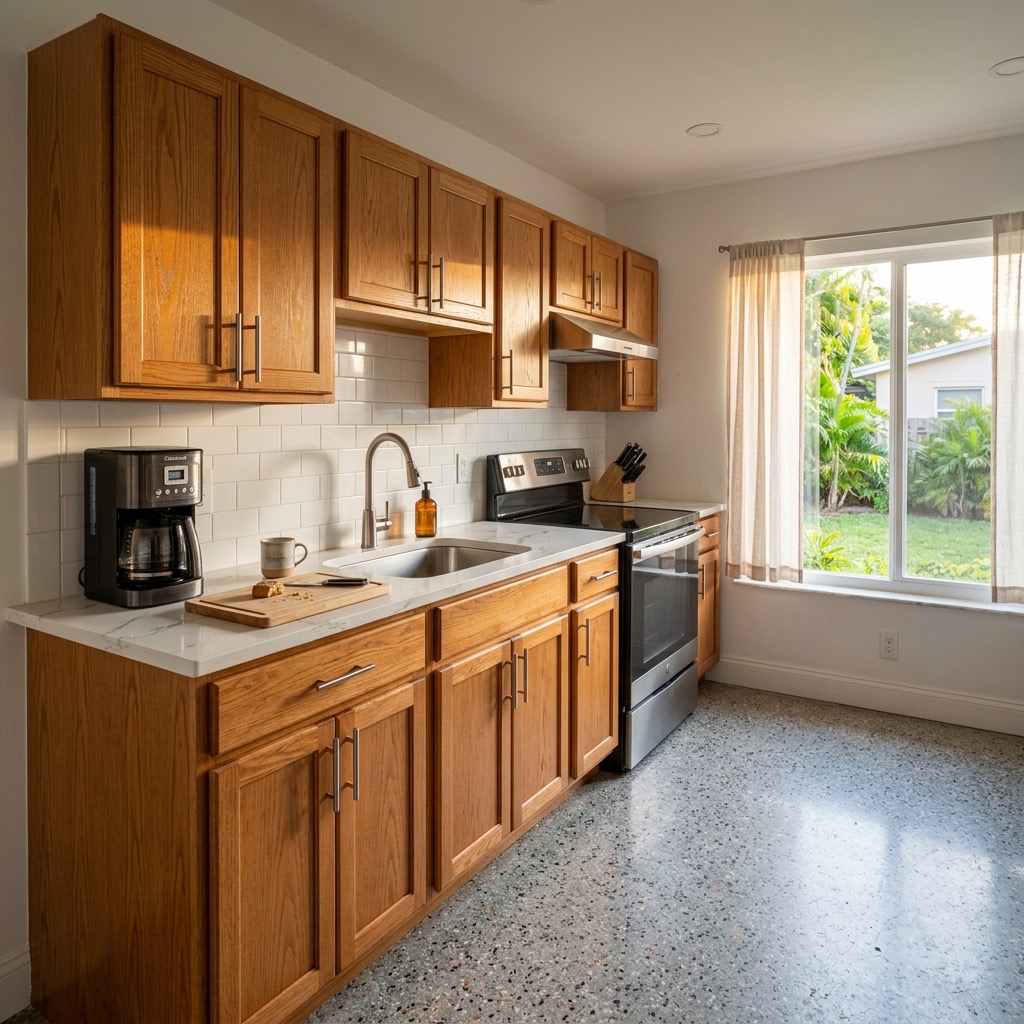
Your Countertop Has to Survive Miami
Picking a countertop in Michigan is different than picking one in Miami. Here, your kitchen deals with humidity year-round. Air conditioning runs constantly, creating temperature swings between the indoor air and the outdoor heat that seeps in every time a door opens. Cooking adds steam and grease on top of that.
Your countertop material needs to handle all of it without staining, cracking, or looking worn out in five years.
We install countertops as part of kitchen remodels across Miami-Dade, from Kendall to Coral Gables to Doral. Here is what we have learned about which materials hold up and which ones do not.
Quartz: The Best All-Around Choice
Quartz countertops are engineered stone. They are made of about 90% to 94% ground natural quartz mixed with resins and pigments. The result is a surface that looks like natural stone but performs better in almost every way.
Why Quartz Works in Miami
Non-porous. This is the big one. Quartz does not absorb liquids. Spill coffee, red wine, or lemon juice and it wipes right off. No staining. In Miami's humid climate, a non-porous surface also means no moisture absorption, no mold growth in the stone itself.
No sealing required. Unlike granite or marble, quartz never needs to be sealed. Zero maintenance beyond basic cleaning. For busy Miami families, that is a real advantage.
Consistent appearance. Because it is engineered, you get exactly the pattern and color you picked. No surprises when the slab arrives. Natural stone varies from slab to slab, which can be beautiful but also unpredictable.
Extremely durable. Quartz rates 7 on the Mohs hardness scale. It resists scratches, chips, and daily wear very well.
Where Quartz Falls Short
Heat sensitivity. Direct contact with hot pans can damage the resin binders. Always use a trivet or hot pad. This is not a dealbreaker, but it is something to know.
Not great for outdoor kitchens. UV exposure can discolor quartz over time. If you have an outdoor kitchen (common in Miami), quartz is not the right pick for that space.
Can look too uniform. Some homeowners prefer the natural variation of real stone. Quartz patterns have improved dramatically, but a trained eye can still tell the difference.
Quartz Cost in Miami
- Material: $50 to $120 per square foot
- Installation: $25 to $45 per square foot
- Total installed: $75 to $165 per square foot
For a standard kitchen with 30 to 40 square feet of countertop, expect to pay $2,500 to $5,500 installed. Budget-friendly quartz brands like Silestone Suede and MSI start at the lower end. Premium options like Caesarstone and Cambria run higher.
Granite: The Natural Classic
Granite has been the go-to countertop for decades. It is natural stone, quarried in large slabs, and every piece is unique. There is a reason it has stayed popular for so long.
Why Granite Works in Miami
Heat resistant. You can set a hot pan directly on granite without damaging it. For serious cooks, this matters.
Unique appearance. Every slab has its own pattern, movement, and color variation. If you want something that looks one-of-a-kind, granite delivers.
Extremely hard. Granite is one of the hardest natural stones. It resists scratches and holds up to heavy use.
Proven track record. Granite kitchens from 20 years ago still look good. It is a material with a long history of performance.
Where Granite Falls Short
Porous. Granite absorbs liquids if not properly sealed. In Miami's humid environment, unsealed granite can absorb moisture and potentially harbor bacteria. You need to reseal it every 1 to 2 years.
Maintenance. That resealing schedule is not difficult, but it is one more thing to remember. Most homeowners forget, and the granite suffers for it.
Inconsistent quality. Not all granite is equal. Some varieties are much more porous than others. Lighter colors tend to stain more easily. You need to know what you are buying.
Can crack. Granite is hard but brittle. A heavy impact on an unsupported overhang can cause a crack. Proper installation with adequate support prevents this, but it happens.
Granite Cost in Miami
- Material: $40 to $100 per square foot
- Installation: $20 to $40 per square foot
- Total installed: $60 to $140 per square foot
For a standard kitchen, expect $2,000 to $5,000 installed. Common colors like Uba Tuba, Santa Cecilia, and New Venetian Gold sit at the lower end. Exotic slabs with dramatic veining cost more.
Marble: Beautiful but High Maintenance
Marble is stunning. Nothing else looks like it. The veining, the depth, the way it catches light. But marble in a kitchen is a commitment, especially in Miami.
Why Homeowners Want Marble
Unmatched beauty. Carrara, Calacatta, Statuario. These names are synonymous with luxury for a reason. Marble has a depth and warmth that engineered materials cannot replicate.
Cool surface. Marble stays naturally cool, which is nice in a Miami kitchen.
Increases home value. Marble countertops are a luxury feature that buyers notice.
Where Marble Struggles in Miami Kitchens
Very porous. Marble absorbs stains faster than granite. Lemon juice, tomato sauce, wine, and vinegar can etch the surface within minutes. In a kitchen where you actually cook, this is a constant battle.
Requires frequent sealing. Every 6 to 12 months. More often than granite. And even with sealing, acidic substances can still etch the surface.
Scratches easily. Marble is softer than granite and quartz. Cutting directly on it will leave marks.
Humidity issues. Miami's humidity combined with marble's porosity means moisture can get into the stone. Over time, this can cause discoloration or promote mold growth on the underside.
Etching. This is the big one. Any acidic liquid leaves a dull spot on marble. It is not a stain exactly. It is a chemical reaction with the calcium carbonate in the stone. You can polish it out, but it is an ongoing maintenance task.
Marble Cost in Miami
- Material: $60 to $150 per square foot
- Installation: $25 to $50 per square foot
- Total installed: $85 to $200 per square foot
For a standard kitchen, expect $3,000 to $7,000+ installed. Carrara is the most affordable marble option. Calacatta and Statuario are significantly more expensive.
Other Options Worth Considering
Butcher Block
Warm, affordable, and easy to install. Works well for islands or secondary prep areas. In Miami, butcher block needs regular oiling (every 1 to 2 months) to prevent moisture absorption. Not ideal for the entire kitchen in our climate, but great as an accent.
Cost: $40 to $80 per square foot installed.
Porcelain Slab
A newer option that is gaining popularity. Large-format porcelain slabs (like Dekton or Neolith) are non-porous, heat resistant, scratch resistant, and UV stable. They work indoors and outdoors. The look can mimic marble or concrete without the maintenance issues.
Cost: $70 to $150 per square foot installed.
Laminate
Do not overlook it for budget renovations. Modern laminate looks better than you think. It is not the laminate from the 1980s. Brands like Formica and Wilsonart offer realistic stone and wood patterns. It will not last as long as stone, but for $15 to $40 per square foot installed, it gets the job done.
Edge Profiles: More Than Cosmetic
The edge profile you choose affects both the look and the cost of your countertop. Here are the most common options:
Straight/Eased Edge. Clean, modern, and the least expensive option. Works with every style.
Beveled Edge. A subtle angled cut that adds a bit of dimension. Slightly more expensive than straight.
Bullnose (Full or Half). A rounded edge. Traditional, soft, and safe around kids. Moderate cost.
Ogee. An S-shaped curve. More formal and elegant. Higher cost due to more shaping work.
Waterfall Edge. The countertop material continues down the side of the cabinet to the floor. Dramatic and modern. Most expensive because it uses more material.
Standard edges (straight, eased, beveled) are usually included in the installation price. Specialty edges add $10 to $30 per linear foot.
What We Recommend for Most Miami Kitchens
For the majority of homeowners we work with across Miami-Dade, quartz is the best choice. It handles humidity without maintenance, it does not stain, it does not need sealing, and it looks great for 15 to 20 years.
If you cook heavily and want natural stone, granite is a solid pick. Just commit to the sealing schedule.
Marble is beautiful in bathrooms, vanities, and accent pieces. For a kitchen where you actually cook daily, think carefully about whether you are willing to keep up with the maintenance.
For a complete guide to planning your kitchen project, see our kitchen remodeling page. And for more detail on countertop choices and installation, check our kitchen countertop guide.
Ready to Pick Your Countertop?
We help homeowners across Miami-Dade choose and install the right countertop for their kitchen. We will walk you through material samples, talk about what works for your cooking habits and family, and give you a clear price.
Call us at (786) 363-7039 for a free consultation. We serve Kendall, West Kendall, Palmetto Bay, Doral, Pinecrest, Coral Gables, The Hammocks, Cutler Bay, and all of Miami-Dade County.
Ready to start your Miami remodel?
Free in-home estimate. We will give you clear next steps.