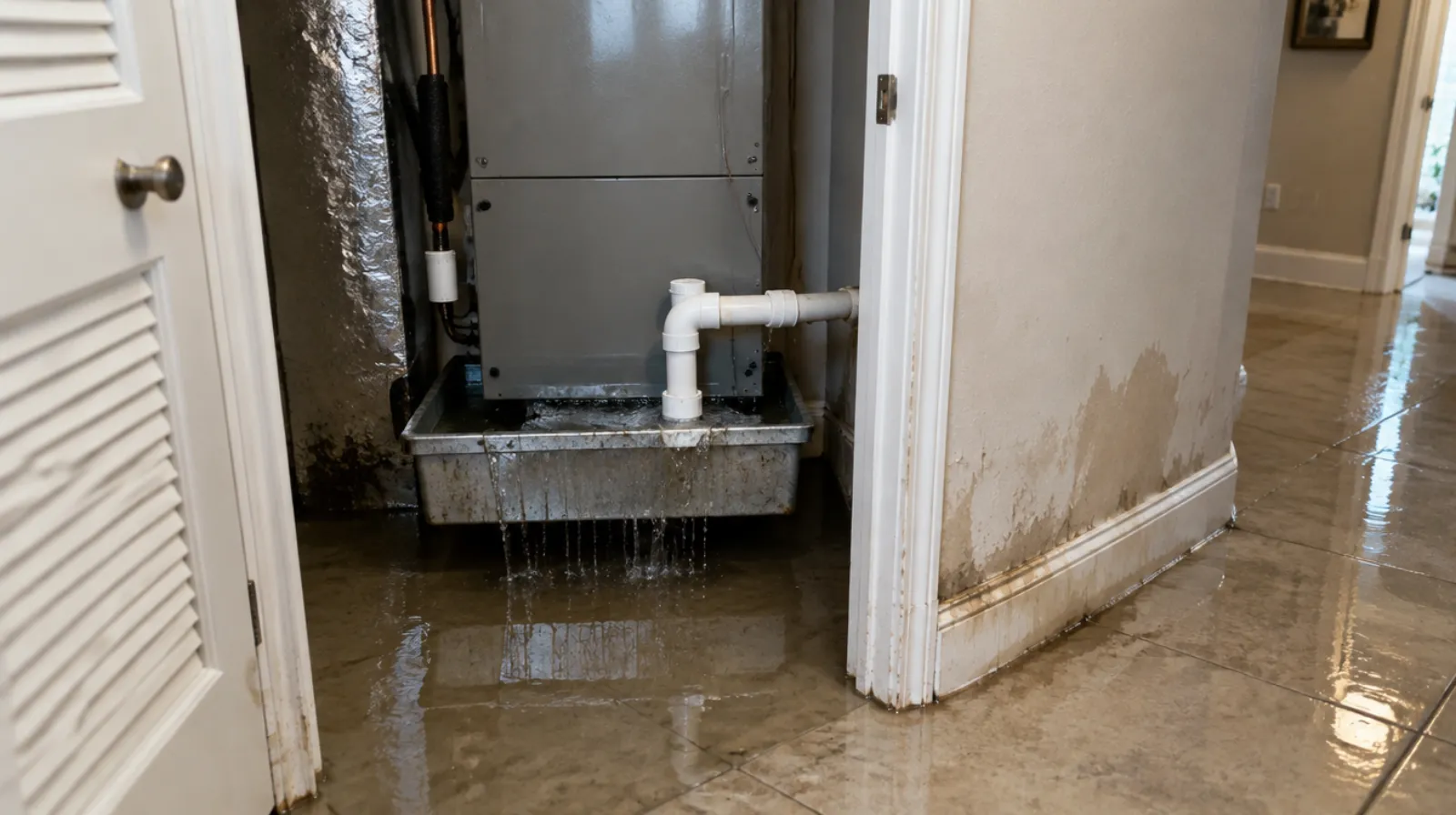
Water from an AC air handler leaking onto a hallway floor in a Miami home, water damage repair
South Florida water damage

AC leaking water inside the house: what to do now

Illustration
Short answer

Turn the AC off at the thermostat and the breaker so the pan stops overflowing. Then find the water: around the air handler, down a hallway, or through the ceiling under an attic unit. Soak it up and photograph it. A clogged condensate line is the usual cause, and an AC tech clears it. We extract and dry what got wet before it turns to mold.

Water in the house right now?
We answer 24/7, nights and weekends too

The EPA says wet drywall, baseboards and flooring should be dried within 24 to 48 hours to prevent mold. Call us. We come look, take moisture readings and tell you what has to go.

Call (786) 363-7039

Signs to look for

  • Water on the floor around the air handler or in a hallway closet
  • A stained, dripping or sagging ceiling under an attic air handler
  • AC that stops cooling or will not start because the float switch tripped
  • Standing water in the drain pan, or a pan that is rusted through
  • A musty or sour smell near the vents or the air handler
  • Ice on the indoor coil or the lines, then water when it melts
  • Swollen baseboard or wet carpet near the air handler closet

If you leave it

  1. Hours: water spreads under flooring and into the bottom of the drywall
  2. 24 to 48 hours: mold can start on materials that stay wet (EPA)
  3. Days: attic insulation and ceiling drywall soak through and start to sag
  4. Weeks: the pan keeps overflowing and the same spot is soaked again and again
  5. A season: the slime in the drain keeps clogging it, so the leak repeats

Updated November 3, 2026

Why AC systems leak water in South Florida

Your AC does not make water. It pulls it out of the air. On a humid Miami day a system can collect gallons of it, and that water has to go somewhere. It drips off the cold coil into a pan and runs out through a condensate line, usually to the outside. Where the AC runs most of the year, that line is one of the busiest drains in the house, and slime grows in it. ENERGY STAR's maintenance checklist says to check the condensate drain and warns that a plugged drain can cause water damage in the house.

When the line clogs, the pan fills and spills. Other causes are a rusted or cracked pan, a line that came loose or lost its slope, and a frozen coil that melts into more water than the pan can take. A dirty filter often starts the freeze, and ENERGY STAR says to check the filter every month. The EPA says to keep AC drip pans clean and the drain lines unobstructed and flowing properly.

Attic air handlers leak differently. Water that spills from the pan lands on the ceiling drywall below, and you may not know until a stain shows. Many units have a float switch that shuts the AC off when the pan fills. If your AC quits on a hot afternoon, look at the pan before you call anyone.

The first hour, step by step

Switch the AC off at the thermostat, then at the breaker. Do not keep running it to see if the leak stops. If the floor around the air handler is wet, stay out of the water, use the breaker at the panel, and do not touch the unit.

Soak up the water with towels or a wet vac, working from the dry edge toward the wet. Set a bucket under any ceiling drip. If the ceiling under an attic unit is bulging, poke one small hole at the lowest point over a bucket so it drains. Lift rugs and anything stored on the closet floor. Photograph all of it, including the pan and the drain line if you can see them.

Call an AC technician to clear the line and check the pan and the float switch. With the AC off, the humidity inside climbs, so start drying while you wait: fans on the wet floor, windows closed, a dehumidifier if you have one. Call us for extraction if the water reached flooring or drywall.

Hallway, closet or ceiling: where AC water goes

A closet air handler leaks out under the door. The water spreads across the hallway floor and soaks into the baseboard, the bottom of the drywall and whatever flooring is there. Tile looks fine until the grout and the subfloor under it hold water. Laminate swells at the seams. Wet carpet and pad hold water for a long time.

An attic unit sends water down through the insulation and into the ceiling drywall, where it pools until the paper face stains and the panel sags. A slow overflow can run for weeks and soak the same spot again and again. The stain is often under the air handler, not under the drain line.

What we do

An AC technician fixes the AC. We deal with the water. The source has to be stopped first, because the restoration standard assumes the owner finds and fixes the source of the water. Drying a house that its own air handler keeps wetting does not work.

Then our IICRC-certified technicians extract standing water and take moisture readings across the floor, the base of the walls and the ceiling. We dry with air movers and dehumidifiers and remove what cannot be saved: wet insulation, soft drywall, carpet pad, swollen baseboard and flooring that has lifted.

After that we rebuild: drywall, paint, baseboard and flooring, so the hallway or the ceiling looks the way it did before.

We handle the reconstruction too: new drywall, baseboards, flooring, tile, cabinets and paint, one crew from extraction to the final walkthrough. See water damage reconstruction.

What insurance usually looks at

Adjusters separate a sudden overflow from a slow drip that ran for months, and they ask how the system was maintained. Keep the AC technician's invoice, since it shows what failed. If the drain was clogged for a long time, or the pan was rusted through, expect questions about maintenance. Your policy wording decides what applies.

We document the damage for your adjuster: photos, moisture readings and a written scope of what has to be dried, removed and rebuilt. Report the loss before repairs start. Our insurance guide shows the steps in order.

Ask us to come look

Leave your details and we call you back. If water is running right now, call instead.

Common questions

Is it safe to keep running the AC when it is leaking water?

No. Turn it off at the thermostat and at the breaker. A clogged line only gets worse with the system running, because the coil keeps making water and the pan keeps filling. Water near the air handler also sits close to electrical parts and the blower, and running the system can push the water into the ductwork and the insulation. Many systems have a float switch that shuts them down when the pan fills. If yours stopped on its own, do not reset it and carry on. That switch is telling you the drain is blocked. Leave the system off until an AC technician has cleared the line and checked the pan. The house will get warm and humid while you wait. Run fans on the wet area, keep the windows closed, and use a dehumidifier if you have one.

How do I know if my AC drain line is clogged?

The signs are water in the pan or around the air handler, a musty or sour smell near the unit, the AC shutting off in hot weather, and sometimes a gurgle from the line. If your unit has a secondary drain stub and water drips from it, the main line is blocked. ENERGY STAR lists the condensate drain on its maintenance checklist and warns that a plugged drain can cause water damage. A technician clears the line, checks the pan and the float switch, and tells you whether the pan is rusted. Ask where the line ends outside and check that spot while the AC runs on a humid day, because a line that drips nothing then is a warning sign. Slime comes back, so ask how often the line should be cleaned for your system. Do not wait for the first stain to find out.

The ceiling under my attic AC is stained. Does it have to be cut open?

Not always. It depends on what the readings show. A stain on firm drywall that reads dry may be fine once the leak is fixed. A ceiling that is soft, sagging or still reading wet needs to come open, because the insulation above it holds water and the back of the drywall stays wet. Moisture readings across the ceiling show how far the wet area goes. Cutting back to dry, solid material is the usual approach, and wet insulation comes out. Painting over the stain without checking is the worst option, since it hides the problem and traps moisture. Press gently around the stain. If it feels spongy or the paint is bubbling, plan on opening it. If it has been wet for more than a couple of days, a mold assessment may be needed. Our mold guide explains what that involves.

Does homeowners insurance cover water damage from an AC leak?

It can, but your policy wording decides, and the cause matters. Adjusters ask when you first noticed the water, how long it had been leaking, and how the system was maintained. A leak that ran for months is usually treated differently from one that started last week. Policies also tend to separate the water damage from the cost of fixing the AC itself, so ask your insurer what is covered and what is not. Report the loss, keep the AC technician's invoice that shows what failed, photograph everything before cleanup, and keep your receipts. We take photos and moisture readings and write a scope for your adjuster so it is clear what was wet and what has to be rebuilt. Coverage is your insurer's decision, and it helps to ask them for their answer in writing.

Other kinds of water damage

Sources

The image on this page is an illustration, not a photo of one of our jobs.

Water where it should not be?

We answer 24/7 across Miami-Dade, Broward, Palm Beach and Brevard. IICRC-certified technicians get the water out, dry the house and rebuild it.

(786) 363-7039

© 2026 Broke & Fixed Home Solutions. All rights reserved.

Call NowFree Estimate