Updated November 3, 2026
Why roofs leak in South Florida homes
Most roof leaks here are not a hole in the middle of the roof. They sit at the joints: around vents, skylights, valleys and where a wall meets the roof. Florida's Hurricane Retrofit Guide says a roof can leak even when the covering is all in place, because water gets in around, over and under the flashings, and those leaks are hard to find.
Tile roofs shed water, but the underlayment under the tile is what keeps your house dry. When it ages or tears near a cracked or slipped tile, rain finds the gap. Flat roofs on additions, lanais and older Miami homes fail a different way. Water sits. A clogged drain or a low spot lets rain pond until it finds a seam.
Summer storms make all of it worse. Wind pushes rain sideways under tiles and into every weak joint. A stain that shows up in August can come from damage that sat there all dry season.
Why the stain is not always under the leak
Water travels. It runs along a rafter or the top of the decking and drops through the ceiling a long way from where it came in. The stain tells you which room got wet. It does not tell you where the roof opened.
On a bright day, look in the attic for daylight through the deck and for dark, damp wood. Wet, matted insulation and dark rafters point uphill toward the entry. Step only on the framing, never on the drywall between joists, and know that a South Florida attic can get dangerously hot. Take photos and leave the rest to the roofer. Do not pull insulation out of a wet area before it has been photographed.
The first hour, step by step
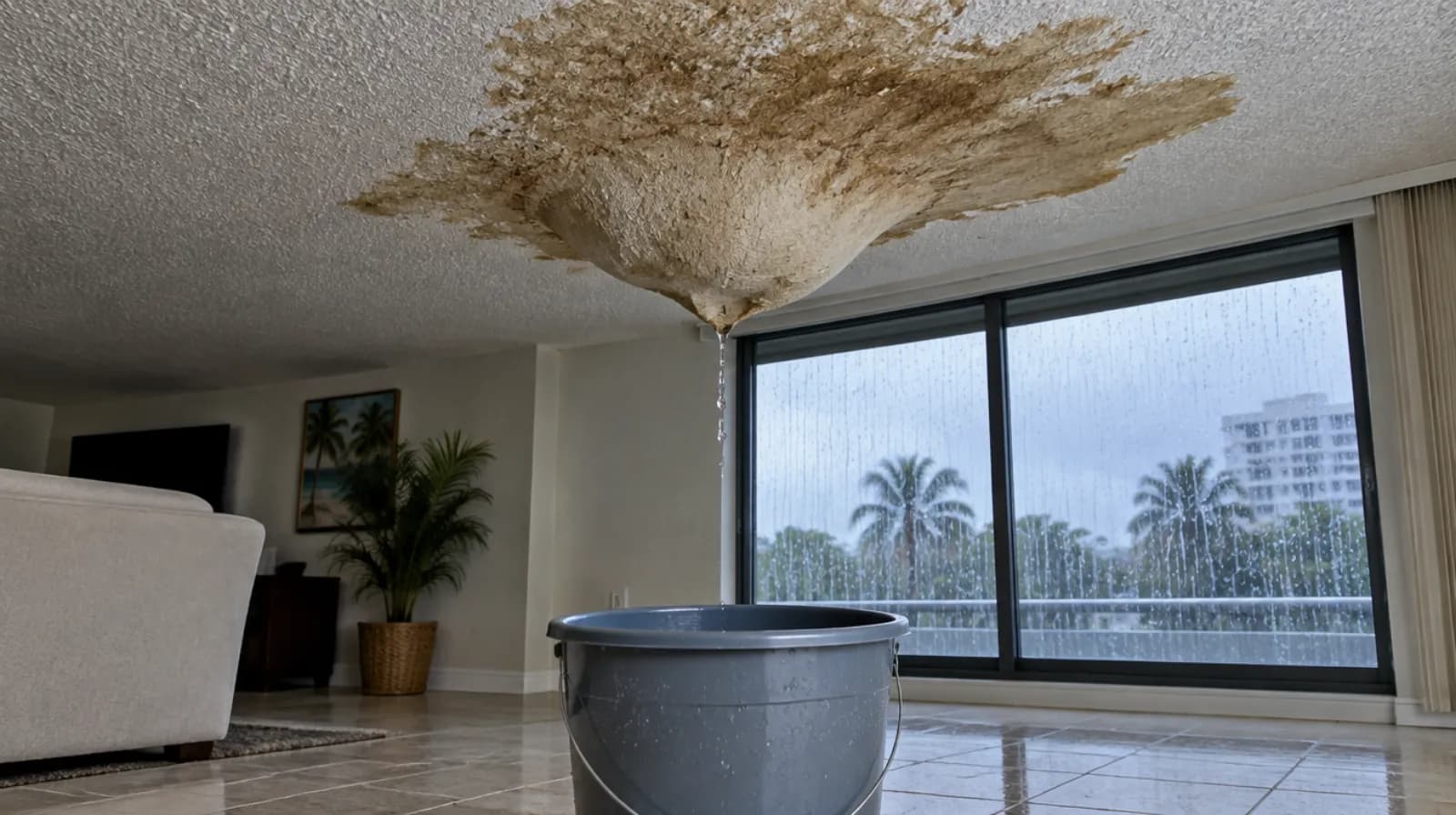
Start inside. Move furniture, rugs and electronics out of the drip zone and put a bucket under it. If the ceiling is bulging, water is trapped in the drywall. Poke one small hole at the lowest point of the bulge with a long screwdriver, standing to the side, so it drains into a bucket instead of letting the whole panel drop. If water is near a light, fan or outlet, switch that circuit off at the panel and leave the fixture alone.
Take photos and video before you clean up: the stain, the drip, the attic if you can reach it safely, and the sky. Stay off the roof. The Florida guide says not to go up when it is slippery or wet, or when it is a concrete or clay tile roof. Call a roofer to find the opening and put a tarp or a temporary patch on it.
Keep every receipt. Florida's Department of Financial Services tells homeowners to protect the property from further damage, with a tarp on the roof for example, to take photos before and after the repair, and to keep receipts.
What we do inside the house
A roofer fixes the roof. We deal with what the water did to the inside. Our IICRC-certified technicians extract standing water, then take moisture readings in the ceiling, the walls under it and the insulation above it, because a ceiling that feels dry can still be holding water.
Then we dry in place with air movers and dehumidifiers, and we take out what cannot be saved. Wet insulation almost always goes. Drywall that has sagged or gone soft goes. A stained ceiling that is still firm may dry and stay, and the readings tell us which one you have. Where something has to come out, we cut back to dry, solid material.
When the readings show the structure is dry, we rebuild: new drywall, texture, and interior painting so the ceiling matches the room. If the attic framing got wet too, the written scope says so.
We handle the reconstruction too: new drywall, baseboards, flooring, tile, cabinets and paint, one crew from extraction to the final walkthrough. See water damage reconstruction.
What insurance usually looks at
Policies differ, so your wording decides. In general, an adjuster asks when the leak started, whether the water came in suddenly or over a long time, and what opened the roof. Storm damage and plain wear are often treated differently. Some insurers also ask about the age and condition of the roof.
Your claim stays between you and your insurer. What we do is document the damage for your adjuster: dated photos, moisture readings, a map of what is wet, and a written scope of what has to come out and be rebuilt. Report the loss to your insurer or agent first. Our insurance guide walks through the steps.