Updated November 3, 2026
Where pipes fail in South Florida homes
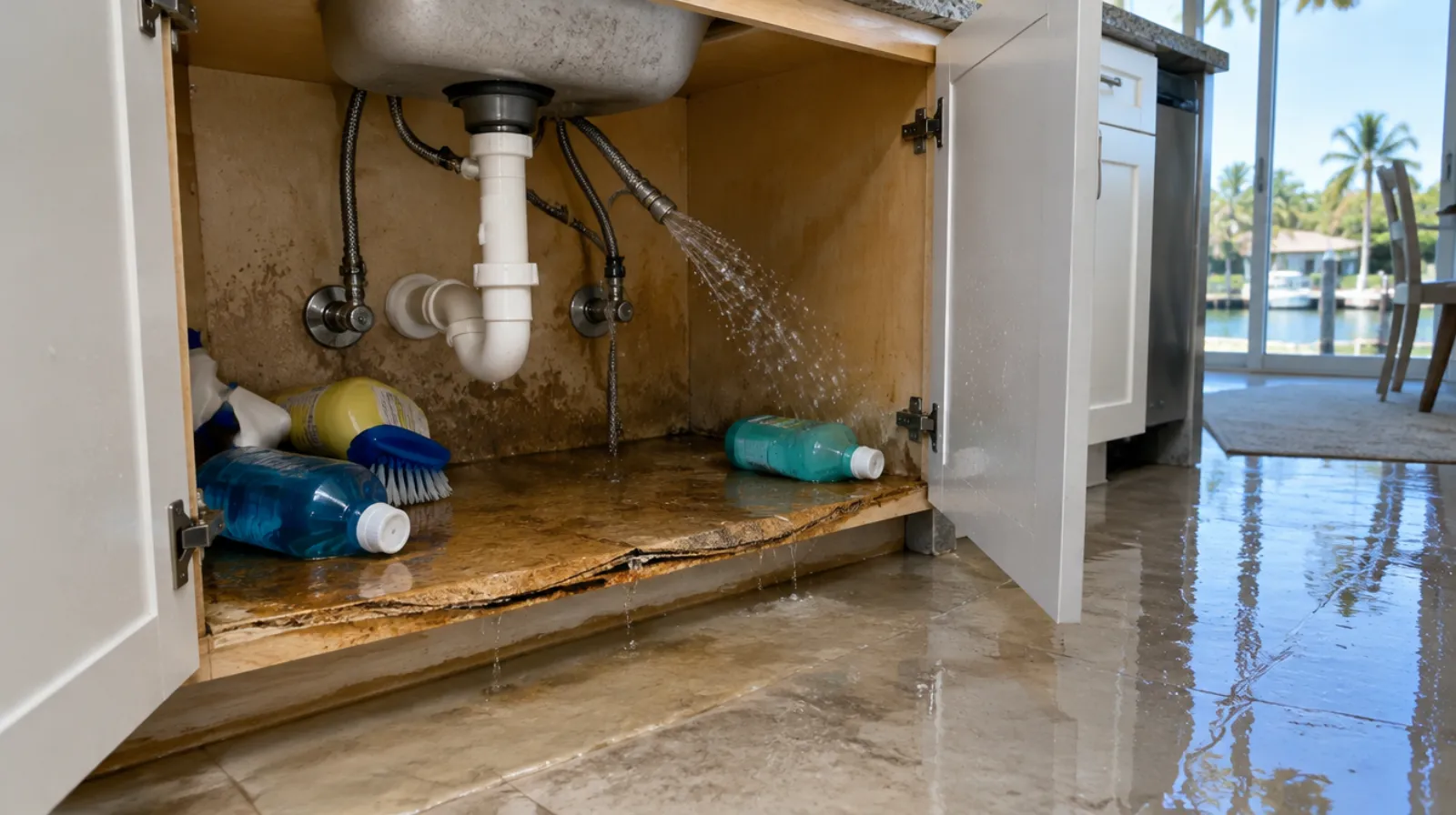
Hard freezes are rare here, so a burst here is rarely ice. It is a failed part. The braided hose under a sink or behind a toilet, the washing machine hoses, the dishwasher connection and the thin ice maker line behind the fridge all wear out. When one lets go, it runs at full line pressure until someone shuts the water off. Old copper and galvanized pipe can also pinhole or split at a fitting.
A burst inside a wall, a cabinet or the floor edge is the expensive kind, because nobody sees it. Water runs down the framing, along the bottom plate and under the floor, and you find it by smell or a soft spot. If the wet spot sits in the middle of a concrete floor, that is a different job, and our page on slab leaks covers it.
The first hour, step by step
1. Shut off the main water valve. In most houses it is on the front wall of the house or in the meter box near the street, and in a condo it is often in a utility closet. If you do not know where yours is, find it today and turn it once so it does not seize. 2. If one fixture is the problem, close its stop valve, the small oval handle under the sink or behind the toilet, and leave the main on for the rest of the house. 3. If water is near outlets, a ceiling light or the panel, do not wade in. Turn off that breaker only if you can reach the panel dry. If you cannot, call an electrician.
4. Take photos and video of the source and every wet surface before you move anything. 5. Lift rugs, boxes and electronics off wet floors, and put foil or plastic blocks under furniture legs. 6. Call a plumber to fix the line. Water in the walls cannot dry while the pipe is still leaking. 7. Call us for extraction and drying, any hour. According to the EPA, mold usually does not grow if wet material is dried within 24 to 48 hours, so the first day matters more than the second.
What we do once the pipe is shut off
We extract the standing water with our own equipment. Then we take moisture readings in the drywall, baseboards, cabinets, subfloor and slab to find where the water went. It goes farther than it looks. Our technicians are IICRC-certified, and the readings tell us what to dry in place and what has to come out. The plumber fixes the line, and we do not do plumbing, so we plan our work around that visit.
Then we dry. Air movers and dehumidifiers run until the readings come back to normal, not until the surface feels dry. Insulation, swollen baseboard, soft cabinet bases, wet carpet pad and the lower part of the drywall come out if they will not dry. Once the house is dry we handle the reconstruction too: new drywall, baseboards, flooring, tile, cabinets and paint, and full kitchen and bathroom work when the damage is big. It is one crew from extraction to the final walkthrough.
We photograph each stage and keep the readings, so there is a record of what was wet, what we removed and why.
What can be saved and what usually cannot
Water from a broken supply line starts out clean. If you catch it fast, painted drywall, solid wood and tile often dry in place. Particle board, MDF baseboard, insulation and carpet pad usually do not come back, because they swell and hold water. Pressed-board cabinet bases are the usual loss in a sink leak.
Where the water came from changes the job. The IICRC puts sewage and waste line backflow in Category 3, the most contaminated class, and those jobs are handled differently from a supply line. Washer and dishwasher discharge carries soap and dirt, so restorers treat it with more care than clean supply water. Our page on wet carpet explains the three categories.
What insurance usually looks at
Homeowners policies usually respond to a sudden and accidental release of water, like a burst line. They often treat a slow leak that ran for weeks or months differently, and many pay to open a wall to reach the pipe but not to fix the pipe itself. Your policy wording and your adjuster decide, so read the water damage section and ask.
We take photos, moisture readings and a written scope of the work for your adjuster. We do not file or negotiate the claim. That stays between you and your insurer. In Florida, a property claim is barred unless you give notice within 1 year after the date of loss, so do not wait. Our insurance claim guide walks through the steps.