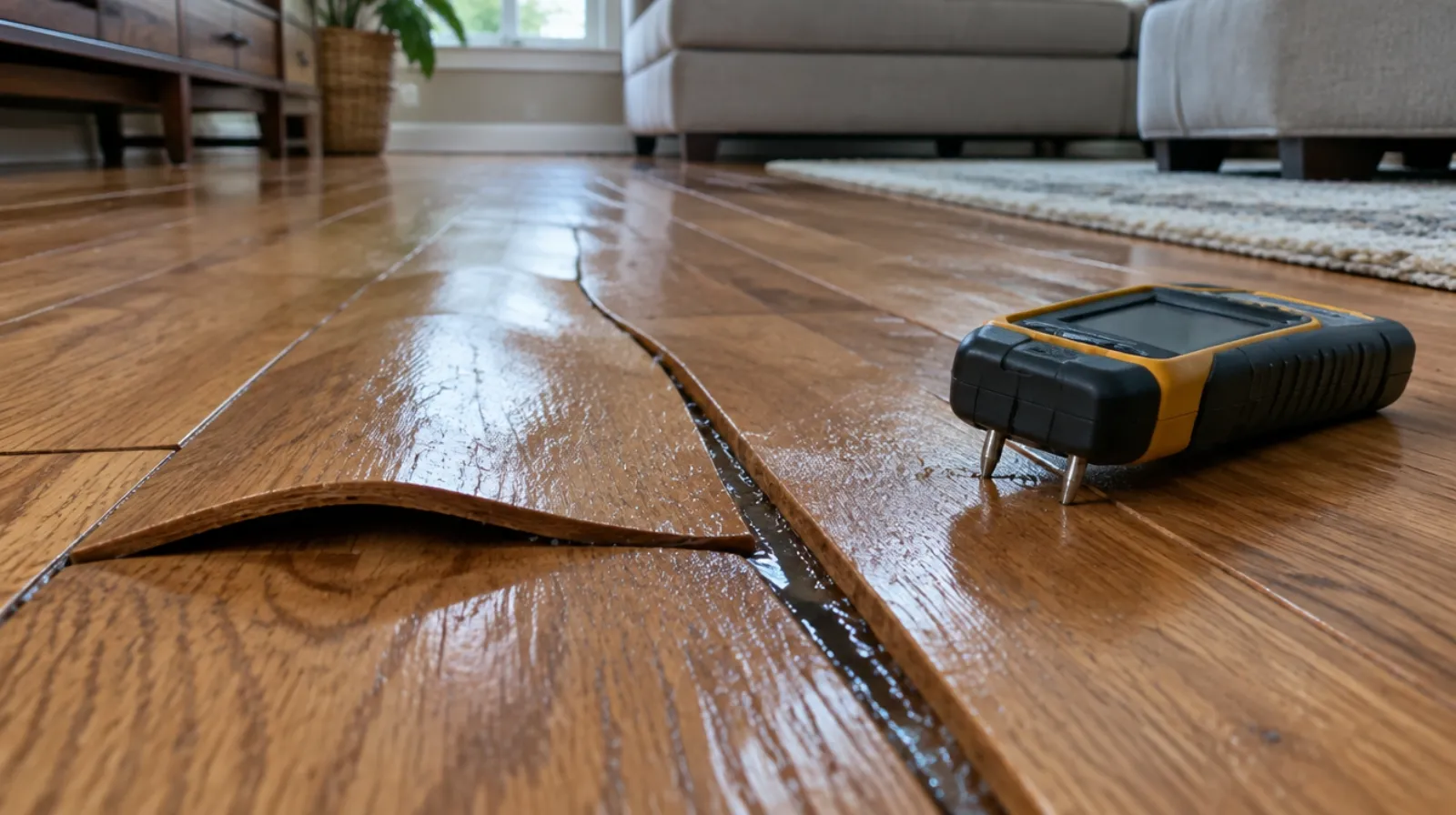
Cupped and buckled hardwood floor boards with a pin moisture meter after water damage in a Miami home
South Florida water damage

Water under hardwood floor: can it be saved?

Illustration
Short answer

Sometimes. If the source is stopped and drying starts fast, minor cupping often relaxes as the wood dries. Buckled boards usually have to be replaced, and the subfloor can be worse off than the boards. We take moisture readings in the wood and subfloor, dry what can be saved and replace the rest.

Water in the house right now?
We answer 24/7, nights and weekends too

The EPA says wet drywall, baseboards and flooring should be dried within 24 to 48 hours to prevent mold. Call us. We come look, take moisture readings and tell you what has to go.

Call (786) 363-7039

Signs to look for

  • Board edges higher than the middle (cupping)
  • Boards humped in the center (crowning)
  • Planks lifting off the subfloor in waves (buckling)
  • Gaps opening between boards, or boards pushing against the walls
  • Dark stains, white haze or a musty smell on or under the floor
  • Laminate or vinyl plank seams that swell or peak
  • Floor that feels soft, springy or loose underfoot

If you leave it

  1. First hours: water moves under the boards and into the subfloor
  2. 24 to 48 hours: mold can start on wet wood and underlayment (EPA)
  3. A few days: boards cup, the finish clouds and gaps open
  4. A week or more: cupping can set and boards stay out of shape
  5. Weeks: boards buckle as nails and glue let go
  6. Long term: dark stains, rot at the edges and a subfloor that has to be replaced

Updated November 3, 2026

How water gets under floors in South Florida homes

Most of it is slow. A supply line or drain leaking under a cabinet, an AC drain line that overflowed, a water heater that failed in a closet, a window that let in storm rain, a washing machine that ran over, or a slab leak pushing water up through the concrete. The water runs to the edge of the floor and under the boards where you cannot see it. Many floors here are engineered wood, laminate or vinyl plank, because they go over a concrete slab, and they react differently from solid wood.

Humidity matters too. Wood takes on and gives off moisture with the air. A house with the AC off for days after a storm can move a floor on its own. That is why we read the wood and the subfloor before we call a floor damaged, and why the cause has to be found before anyone replaces boards.

The first hour: what helps and what hurts

1. Stop the source, or have a plumber stop it. 2. Take up standing water with towels or a wet vac, and keep the vac away from wet outlets. 3. Pull rugs, mats and furniture off the floor, and put foil or plastic blocks under the legs. 4. Run the AC and fans. Do not open the windows, because the air outside in Miami is as wet as the air inside. 5. Take photos and video, with a coin or tape measure next to the worst cupping for scale.

Do not sand or refinish a wet floor. Do not nail or screw boards down. Do not cover the floor with plastic or a tarp, because it traps moisture. Do not point a heat gun or hair dryer at the boards, and do not wax or seal it. Wait for readings. Then call us, any hour, and we will start extraction and drying.

Cupping, crowning and buckling: what each one tells us

Cupping is when the edges of each board rise higher than the middle. It usually means the bottom of the board took on more moisture than the top. Crowning is the opposite, with the middle higher than the edges. It often shows up when a cupped floor was sanded flat before it finished drying. Buckling is the serious one. The boards lift away from the subfloor in a hump.

The National Wood Flooring Association says minor damage often fades or disappears as the floor dries out, and that airflow and heat can speed the drying. It also says a buckled floor needs replacing wherever the buckling happened, because the nails or glue no longer hold and the floor will not return to its original state. The subfloor can be worse off than the boards above it. That is why we do not sand or replace anything until the readings settle.

What can be saved: solid, engineered, laminate and vinyl plank

Solid wood has the best chance. It is thick and it can be sanded, and FEMA's repair guide says some wood floors regain their shape if they dry naturally and may need a little sanding afterward. Engineered wood has a thin wear layer over plywood or fiberboard. If the water was clean and the drying was quick, some engineered floors can be saved. If the core swells or the layers separate, they cannot.

Laminate has a fiberboard core. Water gets in at the seams, the edges swell and peak, and they do not go back down. Plan on replacing it, usually across the whole connected area, because the planks click together. Vinyl plank can shrug off water on top, but water runs under it and gets trapped against the slab or subfloor. We pull a few planks along the wettest wall and look.

Saltwater flooding changes the answer, because the water can be contaminated and the salt stays in the materials. If your floors got wet from a king tide or storm surge, read our page on flooded floors after a king tide.

What we do, and what insurance looks at

We extract standing water and take moisture readings with pin and pinless meters, on the boards, in the subfloor and on the slab. We also read an unaffected spot for a dry reference. The NWFA's target is a floor within 2 percent of its normal in-use moisture content. Then we dry with air movers and dehumidifiers and read again each visit, until the wood matches the reference. Boards that stay out of shape after drying are sanded or replaced. A damaged subfloor is replaced first. Then we handle the reconstruction too: new boards or a full floor, baseboards, drywall and paint, with one crew from extraction to the final walkthrough.

For your adjuster we take photos, readings and a written scope that shows where the floor runs through the house. We do not file or negotiate the claim. Hardwood is where matching comes up most, since a new board rarely matches the old finish. Our insurance guide explains what to ask, and the FAQs below cover the Florida matching rule.

Ask us to come look

Leave your details and we call you back. If water is running right now, call instead.

Common questions

Will cupped hardwood floors go back flat?

Often, if the cupping is minor and the cause is fixed. The National Wood Flooring Association says minor damage often fades or even disappears as the floor dries out over time. The key word is time. Wood dries slowly, in days to weeks depending on how wet it got, how thick the boards are and how humid the house is. Do not sand a cupped floor until readings show it has dried and matches an unaffected spot, because sanding a wet floor flat leaves it crowned once it dries. If the floor stays cupped for weeks after the readings are normal, it may be sanded and refinished. If boards have buckled, lifting off the subfloor, they need to be replaced where that happened. We take the readings that tell you which one you have.

How long does a wood floor take to dry after a leak?

There is no fixed number. It depends on how much water got in, whether it came from above or from below, the thickness and species of the wood, and the finish, which slows drying from the top. Expect days to a few weeks, and let the readings decide, not the calendar. The EPA says that if wet material is dried within 24 to 48 hours, in most cases mold will not grow. A floor will not be fully dry that fast, but extraction and airflow in the first two days matter most. A floor can feel dry on top while the boards underneath and the subfloor are still wet, so surface feel tells you little. We run air movers and dehumidifiers and take readings each visit until the wood matches a dry reference spot. If the numbers stall, something is still feeding the floor, and we look for the source.

Can engineered hardwood, laminate or vinyl plank be saved after water gets under it?

Engineered wood sometimes, laminate rarely, vinyl plank often on top but not always underneath. Engineered wood has a real wood top layer over plywood or fiberboard. If the water was clean and the drying started quickly, some engineered floors can be saved. If the core swells or the layers separate, they cannot. Laminate has a fiberboard core that swells at the seams and does not shrink back, so plan on replacing it, usually across the whole connected area. Vinyl plank is waterproof on top, but water gets under it, and the planks may sit on a foam pad or be glued to a wet slab. Pull a few planks along the wettest wall and look underneath. If the pad is wet or the underside is dark, the floor needs to come up so the subfloor can dry.

Will insurance pay to replace my whole wood floor, or just the damaged part?

It depends on the policy, the cause and how the floor runs through the house. Many policies pay for the damaged area, and the hard part is matching. A new board rarely matches the old finish, and a floor that runs through several rooms without a break is hard to patch. Florida law says that unless the policy says otherwise, when replaced items do not match in quality, color or size, the insurer shall make reasonable repairs or replacement of items in adjoining areas. It also lets the insurer weigh the cost and how uniform the result can be. What is reasonable is between you and your insurer. What helps is a clear record: photos of the floor, moisture readings, a written scope that shows where the floor is connected, and a sample plank. We provide that for your adjuster. We do not file or negotiate the claim.

Other kinds of water damage

Sources

The image on this page is an illustration, not a photo of one of our jobs.

Water where it should not be?

We answer 24/7 across Miami-Dade, Broward, Palm Beach and Brevard. IICRC-certified technicians get the water out, dry the house and rebuild it.

(786) 363-7039

© 2026 Broke & Fixed Home Solutions. All rights reserved.

Call NowFree Estimate