Updated November 3, 2026
Where wet carpet comes from in South Florida homes
The usual causes here are an AC drain pan or line that overflowed in a hall closet, a water heater that failed, a toilet or washing machine supply line, a leaking ceiling, and storm rain pushed in around a window or door. In a house on a slab, the water has nowhere to go but sideways, so it spreads under the carpet and pad and soaks the bottom of the walls.
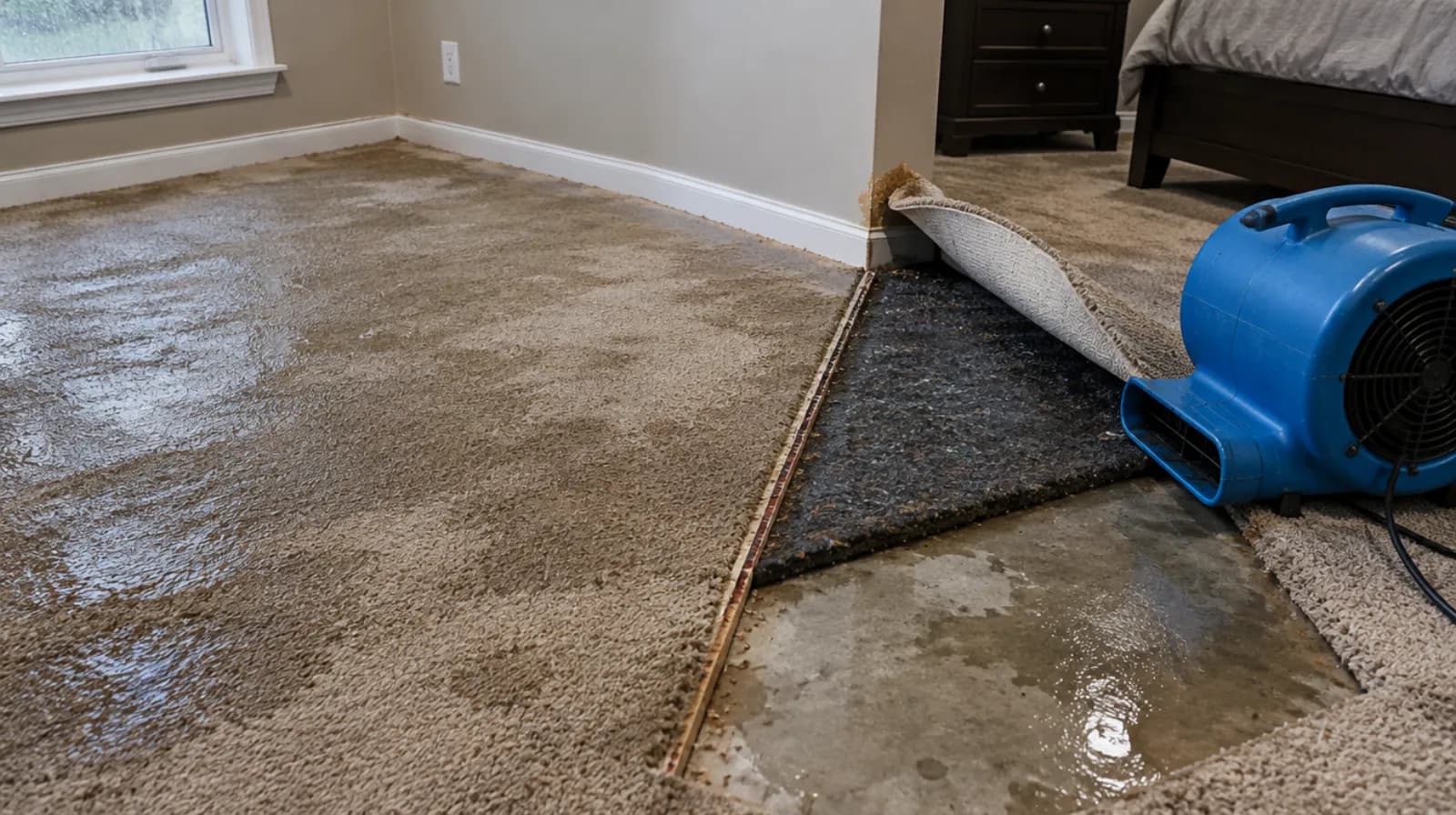
The carpet itself often looks fine at first. The pad is the sponge, and the slab underneath holds water against it. By the time you smell it, the damage under the carpet is usually bigger than what you see on top. Lift a corner at the wall and look.
The first hour: what to do
1. Stop the source. 2. Think about where the water came from. If there is any chance it is sewage or flood water, stay out of it, keep kids and pets away, and wear boots and gloves. 3. Move furniture off the wet carpet and put foil or plastic blocks under the legs, so stains and rust do not spread. 4. Take photos and video of the wet area and the source.
5. Run the AC and fans. Do not use a household vacuum on wet carpet, and keep any equipment away from wet outlets. 6. Walk on it as little as you can. Walking pushes water into the pad and dirt into the backing. 7. Cut a small piece of carpet and pad from a closet or edge as a sample for your adjuster, and keep it. 8. Call us, any hour, to extract and start drying.
Clean, gray and black water: the source decides
Restorers sort water into three categories. Category 1 is clean water, like a broken supply line. Category 2 carries some contamination, like the discharge from a washing machine or dishwasher. Category 3 is grossly contaminated. The IICRC's S500 consensus body lists sewage, waste line backflow from beyond the trap, seawater flooding and rising river water as examples. The restorer sets the category during inspection, and rain that comes through a roof or window is not automatically Category 3.
That sorting decides the carpet. With clean water caught early, the carpet can often stay. FEMA's repair guide says wall-to-wall carpet soaked by clean rainwater can be left in place and dried, while most carpet soaked by floodwater is thrown away. With gray water, the pad goes and the carpet is judged case by case. With black water, carpet and pad go. How long the water sat matters too, because clean water that sits can pick up contamination. We do not guess. We read the carpet, pad and slab and tell you.
The pad, the tack strip and the slab underneath
The pad is the part that usually goes. It is foam that soaks up water and is hard to dry in place, and FEMA's repair guide lists carpet padding among the soaked items that usually get thrown out. When the carpet can stay, we lift it at a wall, pull the pad, dry the slab and the back of the carpet, then lay new pad and re-stretch the carpet.
The tack strip is the wood strip with nails along the wall that holds the carpet. Watch your hands when you lift a corner, because the nails point up. Wet tack strip rusts and the wood can rot at the edge, so we replace it when it was wet for a while. The slab holds water too. Concrete is porous and usually is not damaged by water, but it keeps moisture for a long time, so we read the slab before anything new goes down.
What we do, and what insurance looks at
We extract with our own equipment, then take readings on the carpet, pad, slab, baseboards and the bottom of the walls. Our technicians are IICRC-certified. We pull what cannot be saved, dry the rest with air movers and dehumidifiers, and read again until the numbers are normal. Then we handle the reconstruction too: new pad and carpet, or a switch to tile or other flooring, plus baseboards, drywall and paint, with one crew from extraction to the final walkthrough.
For your adjuster we take photos, readings and a written scope with the room sizes, what category of water we found, and a sample of the carpet and pad. We do not file or negotiate the claim. A sudden leak is the kind policies usually respond to, and a slow one is often treated differently. Our insurance claim guide walks through the steps.