Updated November 3, 2026
Where the rain gets in
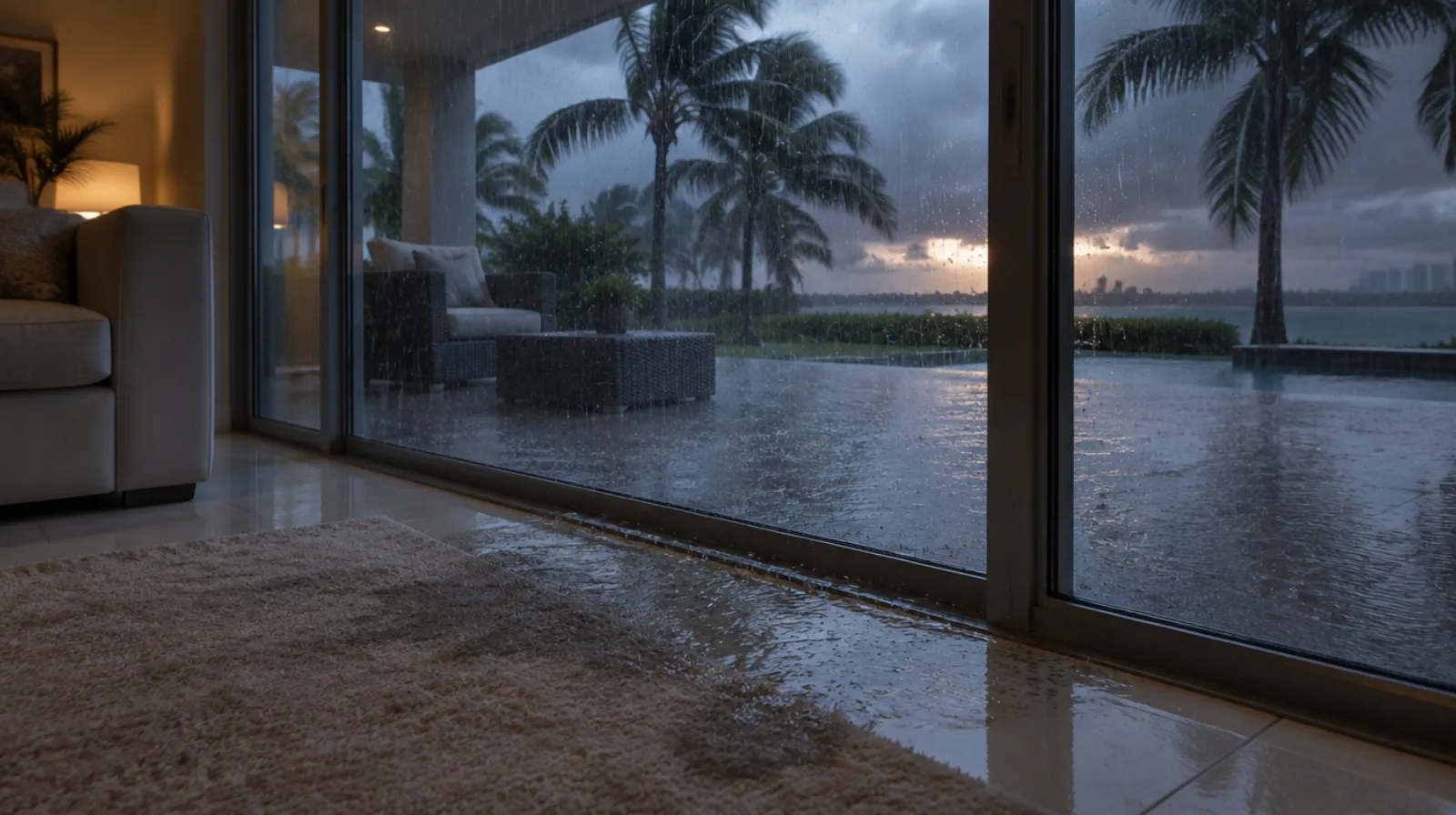
Sliding glass doors are the usual suspect. Wind pushes rain into the track, and the track has weep holes that are supposed to let it back out. When those holes clog with dirt, leaves or caulk, the water has nowhere to go and spills over onto your floor. A Florida Building Commission report on sliding door tracks says past hurricanes caused this kind of intrusion, and notes that some doors lack an adequate sill riser, the raised lip that holds water back.
Windows leak at the sealant, the frame corners and the flashing around the opening. FEMA's advisory after Hurricane Ian lists the common causes: products not tested to the level the wall needs, poor flashing, and sealant that was never maintained. It also warns that water at an opening can cause dry rot and fastener corrosion that weaken the frame and the wall itself.
Walls leak too. Hairline cracks in stucco let water in behind the finish. Concrete block is porous, and after days of rain or a hard, wind-driven storm it can soak through to the inside face. You get damp paint low on the wall with no drip anywhere. When a crack is the cause, exterior repairs on the stucco are part of the fix.
The first hour, step by step
Wipe up the water and lift rugs, curtains and anything cardboard off the floor. Pull furniture away from the wall and lay towels at the base of the door or window. If the water ran toward an outlet, a TV or a power strip, unplug them first. If it ran behind the baseboard or under the flooring, do not just mop. Water under the surface needs extraction and drying, not a towel. The EPA says wet areas should be dry within 24 to 48 hours to prevent mold.
Photograph the wet area, the water line, and the outside of the window or door. Write down the date and the weather. Check the sliding door track and clear leaves, grit and debris out of the weep holes with a thin tool so the track can drain. Do not fill or cover the weep holes.
Do not run caulk over a leaking joint while the wall is wet. Sealant over wet material traps water inside the wall and hides the path it took. Let the area dry, and have the opening looked at when the weather clears.
What actually stops it from coming back
Sealant ages. FEMA says to replace sealant that is cracked or discontinuous, to use one that sticks to that surface, and to make sure it does not block the weep holes. Fixing the opening itself is a job for a window and door company, because they can tell a worn seal from a bad installation or missing flashing. On the wall side, we repair cracked stucco and the exterior finish.
Order matters. If we dry and rebuild the wall and the opening still leaks, the next storm undoes the work. Get the source fixed, or at least identified, before the final paint goes on. A fresh coat over a wall that is still taking water only hides the problem for a month or two.
What we do inside
We start with extraction, then moisture readings along the base of the wall, behind the baseboard, in the floor and in the wall below the window. Rain that comes in at a sill often runs down inside the wall cavity, so the wet part can be lower than where you saw the water. We dry with air movers and dehumidifiers, and we take out what cannot be saved: baseboard, wet insulation, soft drywall, and flooring that swelled or lifted. Our technicians are IICRC-certified.
Then we rebuild. Drywall, baseboard, interior painting, and the floor, whether that is tile, laminate, vinyl or wood. If the stucco around the opening is cracked, we repair it and paint to match.
We handle the reconstruction too: new drywall, baseboards, flooring, tile, cabinets and paint, one crew from extraction to the final walkthrough. See water damage reconstruction.
What insurance usually looks at
Policies differ. Insurers often want to know whether the rain came through an opening a storm created, or through a seal or joint that wore out over time, and how long water has been getting in. Some policies treat those two cases differently, so read the water and storm sections of yours. Triple-I describes wind-driven rain as water damage that homeowners policies commonly cover, but the cause and your wording still decide.
We document the damage for your adjuster: photos, moisture readings, where the water traveled, and a written scope to dry and rebuild. Report the loss to your insurer or agent before repairs begin, and keep your receipts.