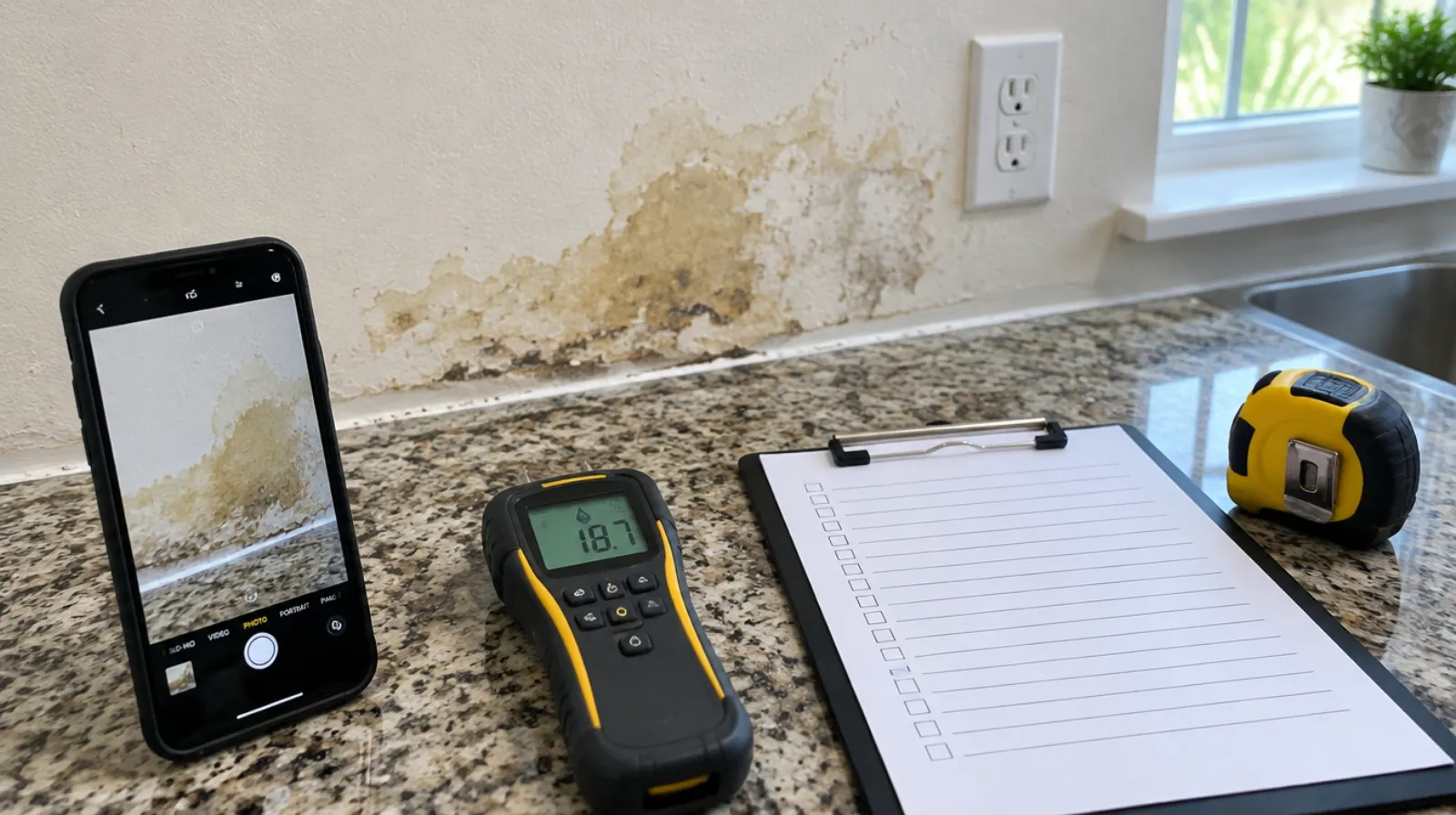
Phone camera, moisture meter, clipboard checklist and tape measure in front of a water stained wall, documenting a water damage insurance claim in Florida
South Florida water damage

How do I file a water damage claim with my homeowners insurance in Florida?

Illustration
Short answer

Report the loss to your insurer when you find it, then stop the water and start drying. Your policy requires reasonable steps to prevent more damage. Photograph everything before you move it and keep every receipt. Florida bars a new claim unless notice comes within one year of the date of loss. Waiting makes mold and a denial more likely. Read your policy and ask your agent.

Water in the house right now?
We answer 24/7, nights and weekends too

The EPA says wet drywall, baseboards and flooring should be dried within 24 to 48 hours to prevent mold. Call us. We come look, take moisture readings and tell you what has to go.

Call (786) 363-7039

Signs to look for

  • Your policy declarations page and your insurer's claim phone number
  • Photos and video of every wet room, wide shots first and then close ups, taken before anything is moved
  • The date and time you found the damage and what you think caused it
  • A plumber, roofer or AC technician report that names the cause and the repair
  • Moisture readings and a written scope from the company that dries the house
  • A list of damaged belongings with age, cost and photos
  • Every receipt: emergency repairs, drying, hotel stays and meals

If you leave it

  1. 24 to 48 hours: mold can start if the house is not dried (EPA)
  2. Days: damaged items that were thrown out can no longer be inspected
  3. Weeks: a sudden leak starts to look like long-term seepage, which many policies exclude
  4. Weeks to months: the insurer may say you did not prevent further damage
  5. 1 year: the Florida limit to give notice of a new claim (18 months for a supplemental claim)

Updated November 3, 2026

Start here: homeowners policy or flood policy

This page is about the homeowners policy. Water that comes from inside the house or through the roof, like a burst pipe, a leaking water heater, an AC drain line or a roof leak, is where a homeowners claim usually starts. Whether it is covered depends on your policy. Water that rises from outside, like storm surge, a king tide or an overflowing canal, is flood, and a homeowners policy does not cover flood. That takes a separate flood policy.

If the water came up from outside, go to our guide on a flood insurance claim in Florida and the main king tide flooding pages. If it came from a pipe, a fixture, the AC or the roof, stay here. Our water damage page lists every common cause, and the burst pipe page covers the plumbing case.

Sudden and accidental, or slow and long-term

Most homeowners policies are written to cover water damage that is sudden and accidental. A pipe that bursts, a hose that lets go, a water heater that fails. They usually do not cover wear and tear, neglect, or constant or repeated seepage or leakage over a period of time. Some policies put a number on that last one, like 14 days or more. The wording is different from policy to policy.

That is why the first hours matter. Find the source, shut off the water, and write down the date and time you found it. A slow leak inside a wall is the gray area. If you have a plumber's report showing when and how the pipe failed, and moisture readings that match, you have something to show your adjuster. Some policies pay for the damage the water caused but not for the part that broke. Read yours to see how it treats each.

None of this is legal advice. Your policy is the contract. Read the water damage section and the exclusions, and ask your agent which one fits your loss.

The notice deadline and what the insurer owes you

Florida Statute 627.70132 says a claim or reopened claim on a property policy is barred unless you give the insurer notice within 1 year after the date of loss. A supplemental claim, for added loss from the same event, has to be noticed within 18 months. Both are in accordance with the terms of the policy. For storms and other weather events, the statute sets the date of loss as the landfall date or the date NOAA verifies the event.

A year is the outer limit. It is not a target. Your policy may ask for prompt notice, and the longer you wait, the harder it is to show the loss was sudden, that you protected the property, and that the mold did not come from neglect. Call as soon as you find the damage, even if you do not know the cause yet.

Florida also puts deadlines on the insurer. Under Statute 627.70131 it generally has to acknowledge your claim communication within 7 calendar days, and pay or deny the claim within 60 days after it gets notice, unless factors beyond its control apply. Keep a log of every call, email and name.

Your duty to prevent more damage, and what to photograph

Your policy expects you to protect the home from further damage. The Florida Department of Financial Services says you are required by your insurance contract to make temporary repairs to prevent further damage. It says to take pictures before making repairs, keep receipts for emergency repairs, and not dispose of damaged property until the company has inspected it. Shutting off the water, extracting standing water and drying the house are all part of that. Permanent repairs wait for the adjuster.

Citizens Property Insurance tells its policyholders to report as soon as they suspect damage, take photos, keep original receipts for emergency repairs and extra living costs, and not start permanent tear-out until its adjuster has inspected and authorized it. If you have a Citizens policy, read that page and your own policy. Other insurers have their own rules. Call yours and ask.

Photograph like this. Wide shots of each room first, then close ups of each wet wall, floor, ceiling and item. Include the source, the shut-off valve, the damaged pipe or fixture and any water line on the wall. Take a video as you walk through and talk. Photograph serial numbers on damaged appliances. Keep the damaged item or a sample when you can. Do all of it before anything is moved or thrown out.

Documentation, reconstruction and when a public adjuster fits

Here is where we fit. We take 24/7 emergency calls, do water extraction and drying in-house with IICRC-certified technicians, and take photos, moisture readings and a written scope you can hand to your adjuster. After the adjuster has seen the damage, we do the reconstruction too: new drywall, baseboards, flooring, tile, cabinets and paint, one team from extraction to final walkthrough. See our water damage reconstruction page. You file the claim with your insurer. We document the damage for your adjuster, and what the insurer pays is between you and your policy.

A public adjuster is a separate choice. It is a person you hire to represent you in the claim, and the Florida Department of Financial Services oversees them. DFS says public adjusters do not work for your insurance company and must hold a DFS-issued credential. It lists a fee cap of 20 percent of the claim payment for most claims, and 10 percent for one year after a declared emergency. Ask for their DFS number and compare it to a photo ID. You do not have to hire one. We are not public adjusters. That is a different job from ours.

Ask us to come look

Leave your details and we call you back. If water is running right now, call instead.

Common questions

How long do I have to file a water damage claim in Florida?

Florida Statute 627.70132 bars a new or reopened property claim unless you give notice within 1 year after the date of loss, and a supplemental claim, which is added loss from the same event, within 18 months, in accordance with the terms of your policy. That is the legal outer limit. Do not treat it as how long you have. Your policy may call for prompt notice, you are expected to prevent more damage, and mold and rot grow while you wait. Many policies also exclude long-term seepage, so a late report on a slow leak is the hardest kind of claim. Call your insurer as soon as you find the damage, even if you are not sure of the cause or the cost. You can send photos and the scope after. This is not legal advice. Read your policy and ask your agent about your exact deadline.

What if the adjuster says my leak was long-term seepage?

Ask for the decision in writing, and ask which part of the policy they are relying on. Exclusions for constant or repeated seepage or leakage are worded differently from policy to policy, and some use a number of days. Then show what you have: the plumber's report on when and how the pipe failed, moisture readings, dated photos, the dry-out records and any water bills that show normal use. Do not argue from memory. If you disagree, you can ask the insurer to review it, contact the Florida Department of Financial Services, which takes insurance questions and complaints from consumers, talk to a public adjuster, or talk to an attorney who handles property claims. This is not legal advice. We cannot decide coverage. What we can do is document the damage, with photos, moisture readings and a written scope, for your adjuster.

Should I fix the water damage before the adjuster comes?

Fix the emergency, not the whole house. Your policy requires temporary repairs to prevent further damage, so shut off the water, extract standing water and start drying. Do not start permanent tear-out or rebuilding before the adjuster has seen the damage. The Florida Department of Financial Services says not to dispose of damaged property until the company has inspected it, and Citizens says its adjuster must inspect and authorize permanent tear-out. Before you move anything, take photos, video and moisture readings. Keep receipts for every emergency step. If wet drywall is sagging or you see mold, tell the adjuster right away, ask how they want it handled and keep a sample of what you remove. Waiting for an adjuster should not mean waiting to dry. Every day the house stays wet makes the loss bigger. Your insurer decides what it pays. We document the damage as we dry.

Do I need a public adjuster for a water damage claim?

No. Hiring one is your choice, and plenty of homeowners take a small claim on their own. A public adjuster works for you, not for the insurance company. The Florida Department of Financial Services oversees them and says they must hold a DFS-issued credential, so ask for their DFS number and compare it to a photo ID. They are paid a percentage of your claim payment, and DFS lists a cap of 20 percent for most claims and 10 percent for one year after a declared emergency. Read the contract before you sign, and ask how and when you can cancel. One can make sense for a large loss, a disputed claim or a denial. For a small, clear claim you may not need one. We are not public adjusters. We dry the house, document the damage for your adjuster and then do the reconstruction.

Other kinds of water damage

Sources

The image on this page is an illustration, not a photo of one of our jobs.

Water where it should not be?

We answer 24/7 across Miami-Dade, Broward, Palm Beach and Brevard. IICRC-certified technicians get the water out, dry the house and rebuild it.

(786) 363-7039

© 2026 Broke & Fixed Home Solutions. All rights reserved.

Call NowFree Estimate