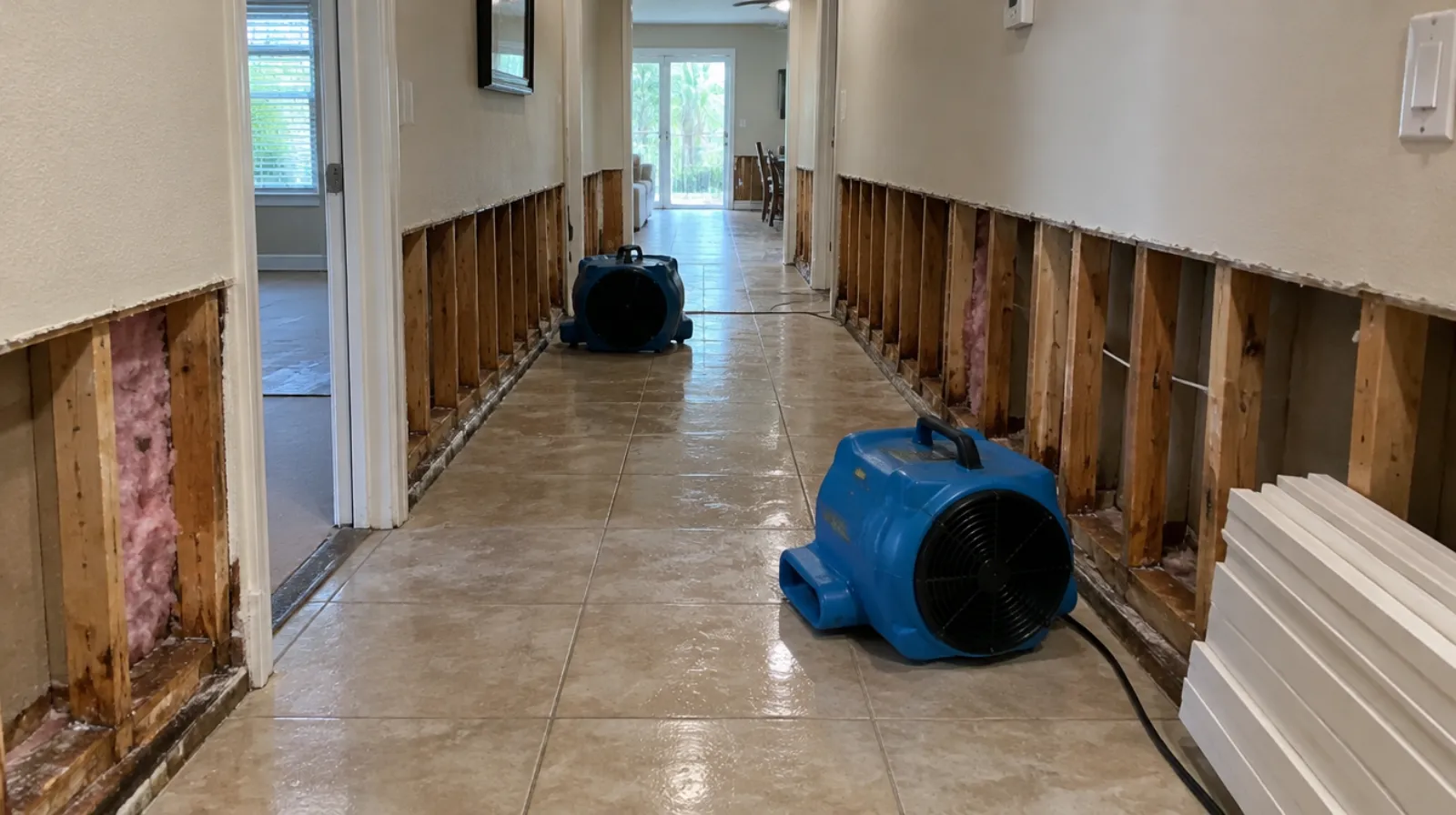
Hallway walls with the lower drywall cut out and two blue air movers drying a tile floor during water damage repair in a Miami home
South Florida water damage

Can water damaged drywall be saved, or does it have to be cut out?

Illustration
Short answer

Sometimes. Drywall that got wet from clean water and was dried within a day or two can often stay. Drywall that stayed wet for days, went soft, sagged, grew mold or got wet from dirty water has to be cut out. The wall also pulls water up past the stain you can see, so a moisture meter, not your eyes, should decide where the cut goes.

Water in the house right now?
We answer 24/7, nights and weekends too

The EPA says wet drywall, baseboards and flooring should be dried within 24 to 48 hours to prevent mold. Call us. We come look, take moisture readings and tell you what has to go.

Call (786) 363-7039

Signs to look for

  • Yellow or brown stains and rings on the wall or ceiling
  • Paint bubbling, peeling or cracking
  • Soft, crumbly or swollen spots when you press the board
  • Baseboards lifting, gapping or swelling at the bottom
  • Tape lines and seams showing or cracking open
  • A musty smell even when the wall looks dry
  • A moisture meter that reads wet well above the visible stain

If you leave it

  1. First 24 to 48 hours: the EPA window to dry water-damaged material before mold takes hold
  2. After 48 hours: mold can start on the paper face, often on the back side first
  3. First week: the board softens, sags and loses its strength
  4. Weeks: wet insulation and the bottom of the wall frame stay damp inside the cavity
  5. Months: stains bleed through new paint and baseboards and framing start to rot

Updated November 3, 2026

Why the wall is wetter than it looks

Drywall is a gypsum core wrapped in paper. Both soak up water like a wick. Water that only touched the bottom of the wall can climb a foot or more above the line you see, and it climbs inside the board where no stain shows. FEMA's flood repair guide says wallboard acts like a sponge and draws water up above the water level.

That is why the stain is a bad map. The ring on the wall shows where the water reached on the surface. It does not show where the board stops being wet. A moisture meter does. Take readings every few inches up the wall, mark where they drop to normal, and write the numbers down. Any cut should land above that mark.

The same goes for what is behind the board. Wet insulation, the bottom plate of the wall and the back of the next room's baseboard can all hold water while the face of the wall looks fine.

When wet drywall can be dried and kept

Clean water, caught fast. A supply line that dripped for an hour, an AC drain pan that overflowed, rain that came in around a window and ran down the wall. If the board is firm, flat and not stained brown, and it has been wet a day or two at most, drying in place often works. FEMA's guide says that with foam board insulation or none, and wallboard soaked by clean rainwater, you can dry the walls without removing the wallboard.

Here is how it is done. Pull the baseboard, drill or cut small vent holes low in each wall cavity, and run air movers and a dehumidifier until the meter reads dry at the board and at the framing. In our work that is in-house water extraction and drying by IICRC-certified technicians, with readings logged at each check.

Dry means dry all the way through, not dry to the touch. Paint on the surface dries in hours. The core takes days. The EPA says to dry water-damaged areas within 24 to 48 hours to prevent mold growth. Stop early and the paper stays damp, and mold grows on the back of the board where you cannot see it.

When it has to be cut out

Cut it if any of these is true. The board is soft, crumbly, sagging or bulging. It has brown rings or has been wet more than two days. There is mold on it. The water was dirty, like a sewer backup, a toilet overflow or floodwater. Or the insulation inside is soaked, because the only way to get the insulation out is to open the wall.

A flood cut is a straight horizontal cut made above the highest wet reading, so the new board ties into dry board. The line usually lands a foot or more above that reading. Cut level, take out everything below, pull the wet insulation, and let the cavity air out until the framing reads dry. Then the new board goes in.

Floodwater is its own case. After a flood, FEMA's guide says to remove the lower 4 feet of wallboard when the water was less than 4 feet deep, and all of it when the water reached 4 feet or more. Our floodwater drywall page covers that. If you are not sure what you are looking at, the signs of water damaged drywall will help you read the wall.

Insulation, baseboards and the cabinet toe kick

If the insulation in the wall is wet, the drywall comes off to get it all out. FEMA's guide says blown-in cellulose holds water for a long time and can lose its mold and fire treatment, so wet cellulose gets replaced. Wet fiberglass batts hold water against the framing and flatten, so they come out too. Foam board usually survives.

Baseboards are the first thing to soak and the last to dry. Solid wood often dries out and goes back on. MDF baseboard swells and does not shrink back, so plan to replace it. Behind either one, the bottom edge of the drywall is the wettest spot on the wall.

Kitchen and bathroom cabinets take water through the toe kick. It wicks into the cabinet base and the wall behind it. Pull the kick plate, check the back of the cabinet and the wall behind it, and dry both before anything gets closed up.

Patching, paint and the full reconstruction

Once the readings are normal, the repair is plain drywall work. New board, tape, mud, sand and prime. Use a stain-blocking primer on any patch that sits next to an old stain, or the brown comes back through the paint.

Do not paint wet drywall. Paint seals the face and traps moisture behind it, and the finish blisters. Match the sheen across the whole wall, not just the patch, or the repair shows when light hits it from the side. Our interior painting team does the finish so the wall reads as one surface.

If a claim is open, we take photos and moisture readings first and write a scope your adjuster can read. Then we do the reconstruction too: new drywall, baseboards, flooring, tile, cabinets and paint, one team from extraction to final walkthrough. See how it works on our water damage reconstruction page. Keep any large tear-out until the adjuster has seen it, unless the wall is already failing. The Florida Department of Financial Services says not to dispose of damaged property before the company inspects it. Your insurer decides what it pays. We document the damage for your adjuster. More on the whole subject is on our water damage page.

Ask us to come look

Leave your details and we call you back. If water is running right now, call instead.

Common questions

How high does water wick up drywall?

There is no fixed number. It depends on how long the wall was wet, how much water there was and what the wall is made of. A foot or more above the visible line is common, and a long soak can push it higher. FEMA's guide says wallboard acts like a sponge and pulls water above the water level. The stain you see is only the surface. Inside the board the wet front is often higher, and the paper on the back can be wet where the face looks dry. That is why a moisture meter beats your eyes. We take readings up the wall until they match a dry reference wall, mark that spot and write it down. Those readings and photos also show your adjuster how far the damage really went. Without a meter, treat anything within a foot above the stain as suspect and keep the fans and dehumidifier running until someone has checked it.

Can I just paint over a water stain on drywall?

Only if the leak is fixed and the wall is dry all the way through. If both are true, a stain-blocking primer and two coats of paint will usually hide it for good. If either is false, painting is the wrong move. Paint seals the face of the board and traps moisture behind it, so you get blisters, a musty smell and mold on the back. A stain that comes back through fresh paint tells you water is still getting in, or the wall never finished drying. A soft spot, a bulge or a crumbling edge means the board is done and has to be cut out, not covered. Check the cause first, then check the wall with a meter. If you are not sure, hold off on the paint. Painting too soon costs you the paint job and the wall, and it can cover up evidence your insurance adjuster wants to see.

Should I cut out wet drywall before the insurance adjuster sees it?

Stop the water and start drying first. Your policy requires you to take reasonable steps to prevent more damage, and the Florida Department of Financial Services says you are required by your insurance contract to make temporary repairs. The same office says not to dispose of damaged property until the company has inspected it. Citizens tells its policyholders that its adjuster must inspect and authorize any permanent tear-out. So the order is: shut off the water, take wide and close photos and video, take moisture readings, run the dry-out, and call your insurer the same day. Keep a piece of the removed material if you have to cut something. If a wall is sagging or has mold, tell your adjuster and ask how they want it handled. Read your policy and ask your agent, because wording differs. We document everything for your adjuster. You are the one who files the claim.

How long does wet drywall take to dry?

The meter decides, not the calendar. A small clean-water spot with air movers and a dehumidifier is often a matter of days. Thick walls, wet insulation inside the cavity, an exterior wall, vinyl wallpaper and heavy paint all slow it down. What matters is that you start inside the 24 to 48 hour window the EPA gives, because every extra day the paper stays wet makes mold more likely. On a humid South Florida day, closing the house and running the AC and a dehumidifier works better than opening the windows. If the readings stall, or the board is still soft after drying, it gets cut. We check the wall at each visit and keep the numbers, so the decision to keep it or cut it is based on readings and not on a guess. If you see the board sag or smell mustiness, do not wait for the next check.

Other kinds of water damage

Sources

The image on this page is an illustration, not a photo of one of our jobs.

Water where it should not be?

We answer 24/7 across Miami-Dade, Broward, Palm Beach and Brevard. IICRC-certified technicians get the water out, dry the house and rebuild it.

(786) 363-7039

© 2026 Broke & Fixed Home Solutions. All rights reserved.

Call NowFree Estimate